


In Part 1, we talked about the macro-level erosion of critical thinking — how a half-century of shifting societal baselines, digital abstraction, and systemic exhaustion have left the modern workforce operating in pure survival mode.
But what does that actually look like on the ground? It looks like a critical business process mutating into a massive liability because the people involved simply do not have the cognitive bandwidth to navigate the grey space.
Let’s dissect a real-world scenario (with details heavily altered to protect anonymity). This is the anatomy of a complete organizational FUBAR.
The Setup: A Perfect Storm of Vulnerability
The situation was objectively straightforward: execute a highly sensitive, multi-million-dollar vendor liability contract before a midnight deadline. If the contract lapsed, the company’s supply chain software would be suspended, halting operations.
The stage was set for failure by three key factors:
The Gatekeeper: The VP of Operations & IT — the only person with super user admin access to the digital contract portal — was completely off the grid on a remote, out-of-country trip. Under the premise of “separation of duties,” they had hoarded the system access, effectively creating a single point of failure that brought the company to its knees the moment they lost cell service.
The Leadership Vacuum: With the gatekeeper MIA, the task fell to an IT Manager and an Operations Supervisor, both operating under immense pressure without strong executive oversight.
The Executive Sponsor: The required final authorized signer was an off-site parent company Executive whose Friday night was already booked with an unmissable family obligation: their child’s opening night in their school musical.
The Execution Failure: The Stack of Papers
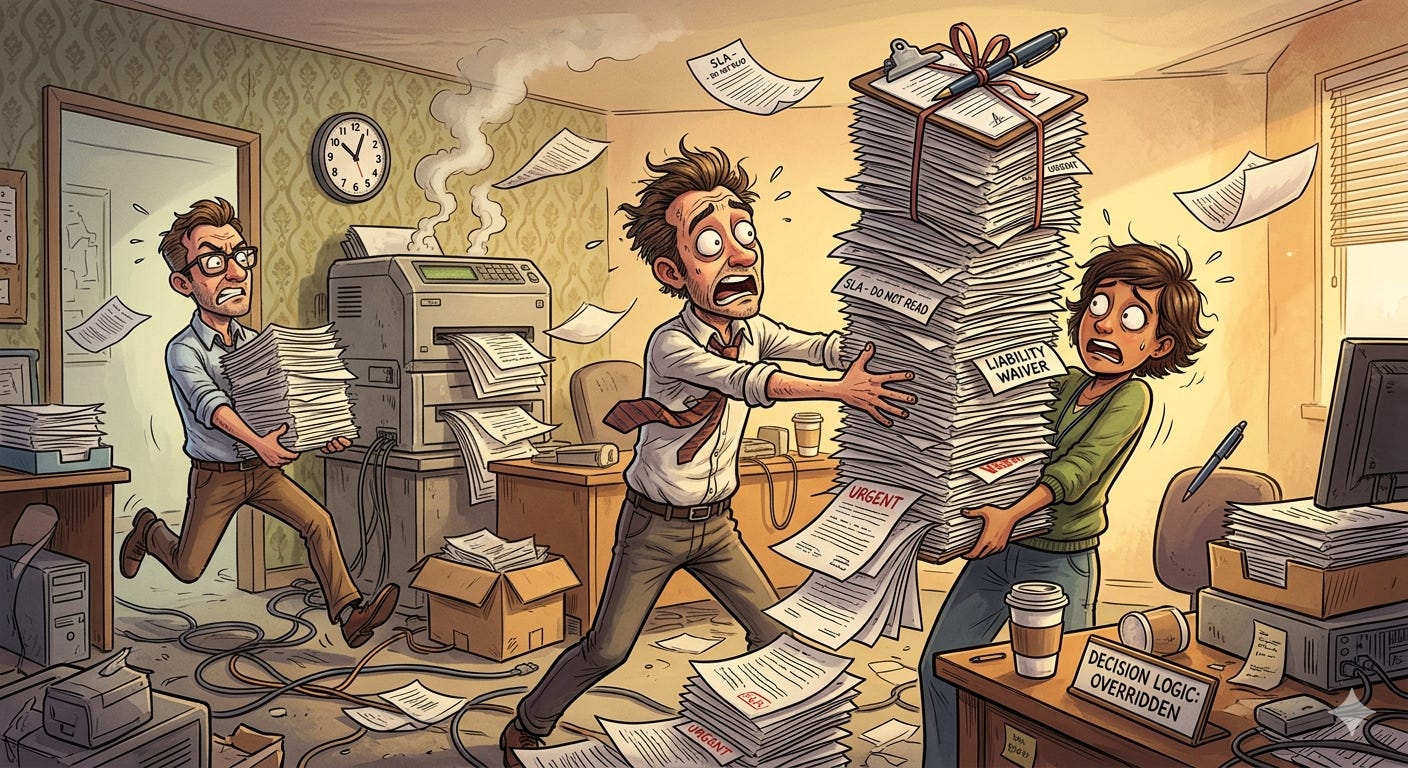
Unable to route the contract digitally, the IT Manager and the Ops Supervisor manually printed and assembled the 150-page Service Level Agreement (SLA) and its associated liability waivers.
Here is where the organization’s deeply siloed culture practically made a catastrophe inevitable. In this company, information hoarding was treated as job security, and “so-and-so handles that” was the default answer to every process question. Because the MIA VP was the only person allowed to manage this vendor relationship, the rest of the team had zero visibility into the contract’s actual requirements.
So, when panic overrode logic, it was truly the blind leading the blind. The IT Manager hastily printed a massive stack of papers — but having no context for what the stack was actually supposed to contain, they simply handed the giant ream to the Operations Supervisor with a dangerously vague directive: “Just get the signatures.”
The Supervisor didn’t verify the stack. It’s tempting to write this off as weaponized compliance or the ultimate CYA defense, but the reality on the ground was far less malicious. This was a junior employee operating entirely in the dark. They understood the basic mechanics — that contracts need signatures — but no one had briefed them on what was in this specific 150-page monolith, let alone that a flagship liability waiver was the critical piece. How could they know? The manager giving the orders didn’t know either.
Thrust into a last-minute crisis with zero context, the Supervisor did exactly what overwhelmed junior employees do in a vacuum: they assumed the person who handed them the papers had already done the quality control. They were handed a stack and told to get it signed, so they ran with it — blindly executing a frantic order within a system built on secrets that was already fundamentally broken.
The Climax: The Cell Phone Flashlight
Because the process had been fumbled all day, it was late Friday evening by the time the Supervisor finally tracked down the Executive.
It is important to note the context here: this C-Suite Executive was from a parent company, highly disconnected from the child organization’s day-to-day operations. They had only been appointed as a proxy at the eleventh hour because the actual VP had to fly out of the country unexpectedly for a personal matter.
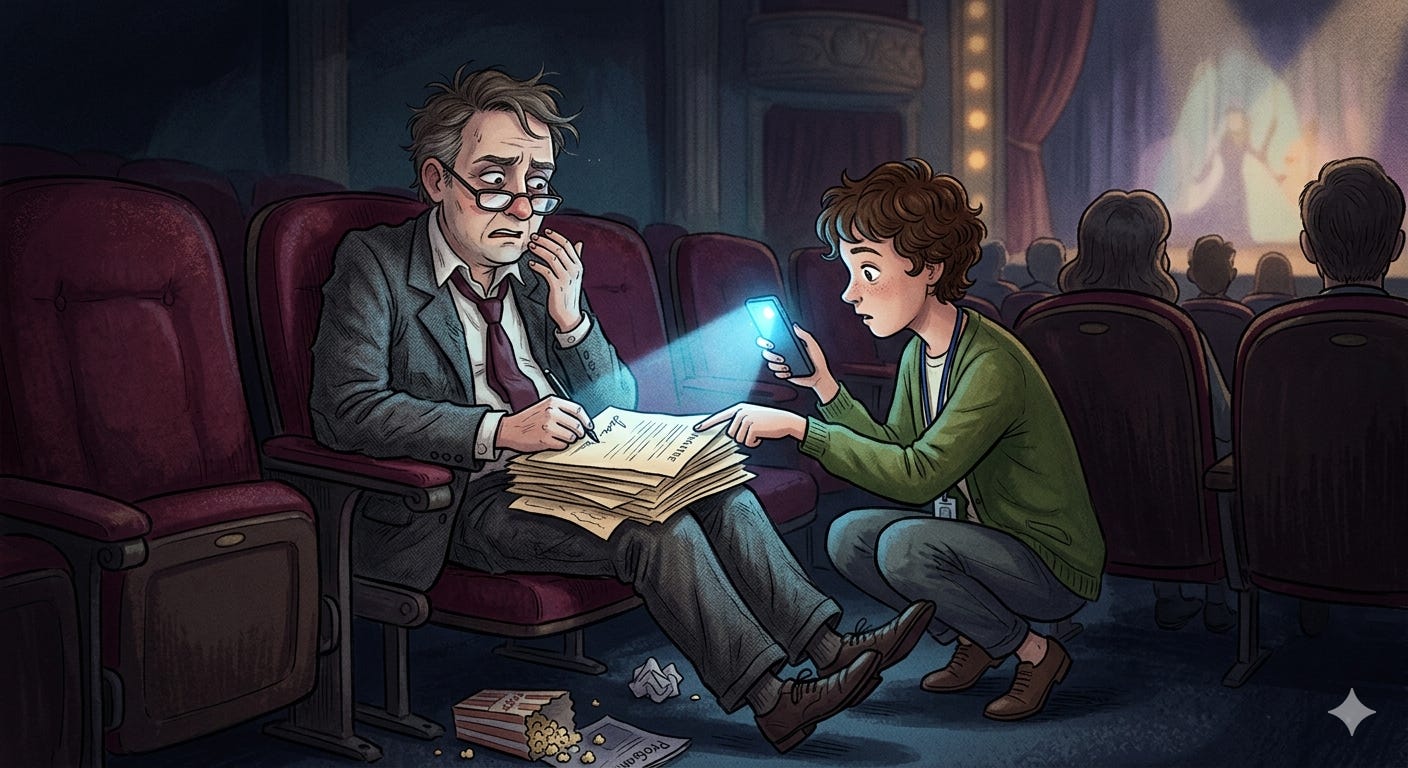
They didn’t meet in a quiet boardroom to go over the transition. The Supervisor, panic-texting from the lobby, snuck into the back of a pitch-black school auditorium mid-performance.
This is where systemic exhaustion takes the wheel.
The Executive, suffering from profound decision fatigue after a grueling week running the parent company, was mortified by the interruption. Whispering furiously in the back row, distracted by the play, and desperate to make the Supervisor go away before causing a scene, they didn’t read a single page. They simply balanced the stack of papers on their lap and signed wherever the Supervisor pointed, illuminated only by the harsh, blue glare of a cell phone flashlight.
This wasn’t a malicious abdication of duty; it was a predictable human surrender to an impossible situation. Thrust into a last-minute emergency for an organization they didn’t run, and pinned down in the dark, they simply trusted that the process handed to them was accurate — a process that was already fundamentally broken.
The Fallout: The Price of the Void
Naturally, the process imploded. When the dust settled on Monday, they realized the actual liability waiver — the single most important page — had never made it into the printed stack.
The consequences? The vendor suspended the software. The company was exposed to severe corporate liability. The Executive threatened to resign over the sheer embarrassment of the operational breakdown. And it took a week of emergency legal maneuvering to fix a problem that should have been handled by a routine digital signature.
The Diagnosis: We Have Lost the Plot
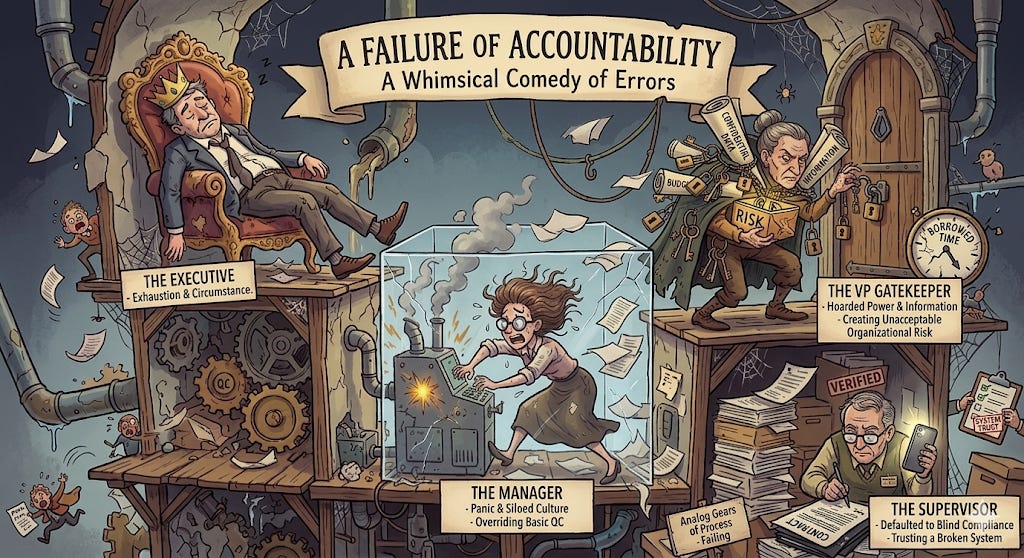
This wasn’t just a comedy of errors. It was a failure of accountability at every single level.
The VP Gatekeeper hoarded power and information, creating an unacceptable organizational risk.
The Manager allowed panic and a siloed culture to override basic quality control.
The Supervisor defaulted to blind compliance, trusting a broken system instead of verifying the details.
The Executive let exhaustion and circumstance dictate their standard of care.
When people no longer understand how the analog gears of a process work, when they are too terrified (or exhausted) to verify the details, and when they are signing contracts in the dark by an iPhone light, your organization is running on borrowed time.
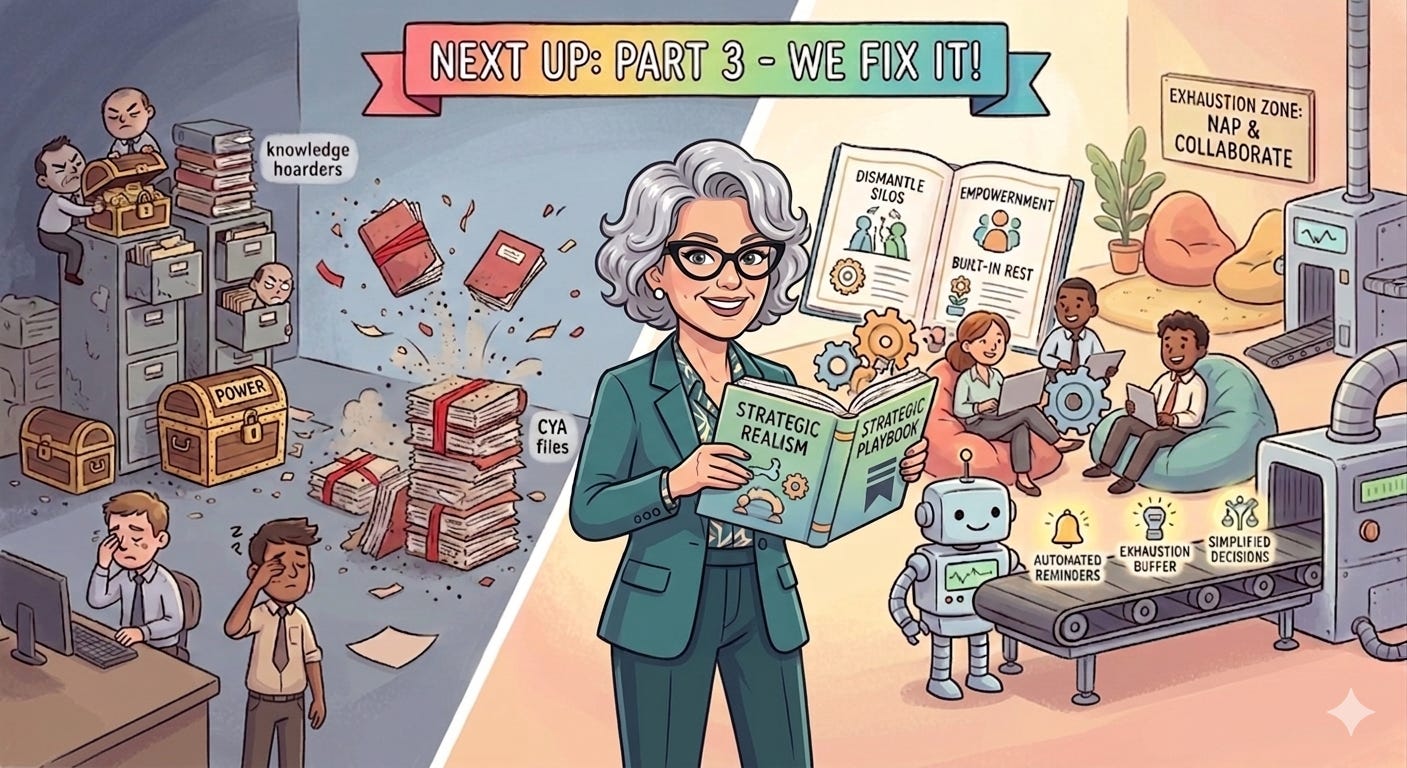
Later this week, in Part 3, we fix it. I’ll be sharing the Strategic Realism playbook for dismantling the power hoarders, curing the CYA culture, and building systems that actually assume exhaustion.
Does this situation sound familiar? I want to hear your war stories: Have you ever been held hostage by a “Single Point of Failure” gatekeeper? Have you witnessed a “cell phone flashlight” sign-off? Drop your experiences in the comments, and make sure you’re following so you don’t miss the fix when it drops later this week. Stay tuned!
