


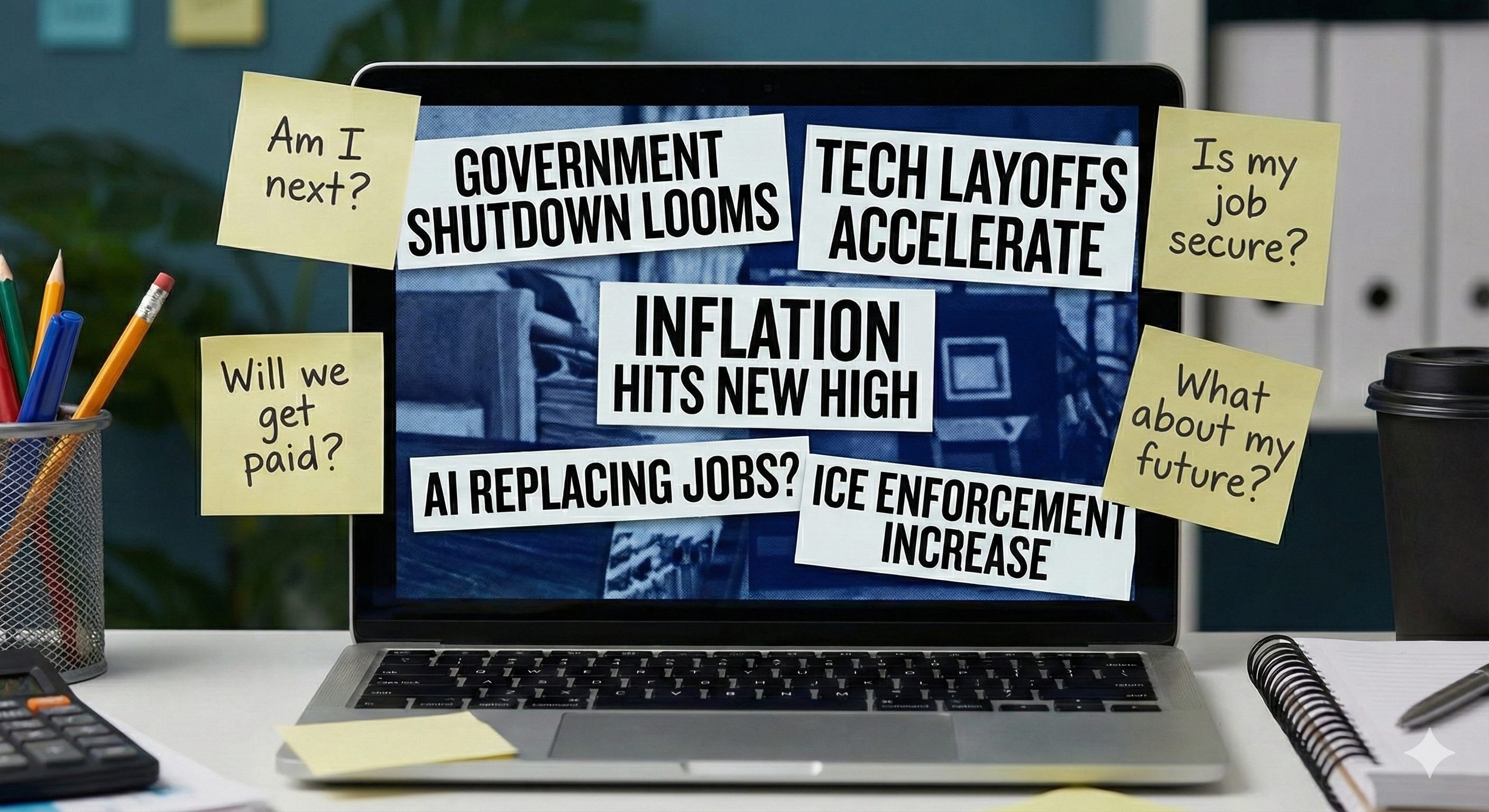
If you walked through your office (or logged onto your team Slack) this morning, you probably felt it. The vibe is heavy.
We have spent the last few days talking about the macro-reasons for this: the broken Social Contract, the distrust in institutions, the feeling that the game is rigged by the entrenched Establishment. But for your employees, that macro-anxiety shows up as very specific, immediate fears:
“Am I next on the layoff list?”
“If the government stays shut down, will our contracts get paid?”
“Is AI actually going to take my job this year?”
“Can I even afford to drive to work with gas prices like this?”
“Is it safe for my family to be out driving with ICE enforcement ramping up?”
Here is the trap most leaders fall into: Because you don’t have the answers to these massive problems, you stay silent. You wait for “good news” before you speak. You think you are projecting calm, but to your team, your silence is deafening.
In the Absence of Information, We Invent Catastrophe
Human beings are hardwired survivalists. When there is a gap in information, our brains don’t fill it with rainbows and unicorns. We fill it with the worst-case scenario.
If you don’t talk about the company’s health this week, your employees aren’t assuming “no news is good news.” They’ve gone into the death spiral. They are assuming you are in a closed-door meeting with a bankruptcy lawyer. They are assuming the silence is the calm before the severance package.

Strategic Realism: The “Pilot in Turbulence” Approach
Think about being on a plane that hits massive turbulence. If the pilot says nothing, you grip the armrest and panic. If the pilot comes on the intercom and says, “Folks, we’re hitting some rough air. I’m going to change altitude to try and smooth it out. I’ll keep you posted,” your heart rate drops.
The pilot didn’t fix the turbulence. They didn’t promise a smooth ride. They just confirmed that someone is flying the plane.
That is Strategic Realism. It isn’t about promising that everything will be fine (Toxic Positivity). It is about confirming that you are awake, you are watching the gauges, and you have a plan for the immediate future.
Actionable Advice: The “State of the Union” Meeting
My advice to every client this week is to hold a brief, all-hands “State of the Union.” Do not wait for the quarterly review. Do it now.
Here is the framework for a stabilizing, transparent meeting that kills the rumor mill without over-promising:
Acknowledge the Noise: Start by validating the elephant in the room. “I know the headlines are scary right now: between the government noise, the layoffs we’re seeing, and inflation. It is heavy, and it’s okay to feel that weight.”
Say What You Know (The Cash Flow Reality): Give them the hard data. “Here is exactly where we stand as a business. Here is our cash flow for the next 30 days. Here are the client contracts we have secured.”
Say What You DON’T Know (The Vulnerability): This builds massive trust. “I don’t know how long ICE may be in our community. I don’t know if our vendor prices will go up again next month.”
The Short-Term Plan: Give them a horizon they can see. “Because of that uncertainty, our focus for February is just these three things: [X, Y, Z]. If we hit these marks, we stay safe. Let’s not worry about Q4 right now. Let’s win February.”

The Result: Psychological Safety
When you have a conversation like this, you aren’t fixing the national economy. You aren’t stopping the inflation, the government chaos, or the AI revolution.
But you are turning the lights on in a dark room. You are replacing their catastrophic fantasies with concrete facts. And right now, facts — even hard ones — are the most comforting thing a leader can offer.
So, don’t be silent this week. Get on the intercom. Let them know you’re flying the plane.