


Looking at the labor market right now, we are seeing a paradox.
On one hand, we have the “entrenched Establishment” — the massive tech, media, and finance giants — shedding tens of thousands of high-performing employees in the name of “efficiency.”
On the other hand, we have Local Business and Nonprofit leaders who have spent the last decade desperate for top-tier talent but unable to match the inflated salaries of the giants.
This is your “Moneyball” moment
For the first time in years, there is a flood of incredible talent hitting the market that is actually accessible to you. But—and this is a massive “but”—you cannot recruit them the way you used to.
The Reality Check: You Are Recruiting Survivors (Again)
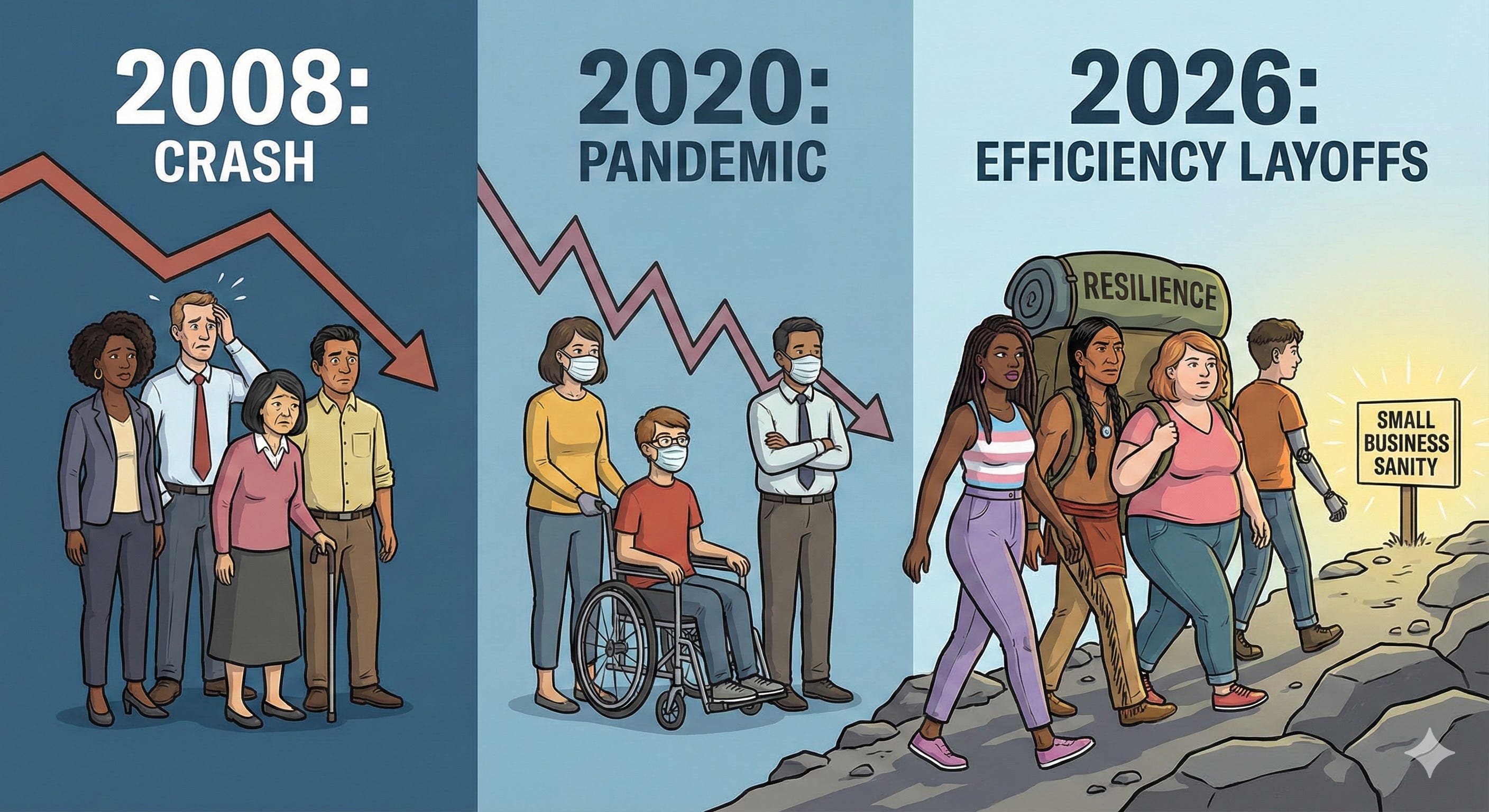
We have to be honest about the human beings sitting across from us in these interviews. They aren’t just “looking for a new challenge.” They are survivors of a cumulative economic trauma that goes back nearly two decades.
The Boomers: Many of them can’t quit. They lost their homes and 401ks in the 2008 crash, spent a decade clawing their way back, and are now watching a volatile market threaten their retirement all over again. They aren’t working for fun; they are working for survival.
Gen X: As usual, we are the “forgotten” generation. We are the latchkey kids of the economy: resilient, cynical, and really effing tired. We’ve survived the Dot Com bust, the 2008 housing collapse, and COVID, usually while caring for aging parents and young kids, and all while being ignored.
Millennials: This group has navigated “unprecedented crisis” after “unprecedented crisis” for their entire adult lives. They entered the workforce during the Great Recession and are now getting fired via email in their prime earning years. Burnout isn’t a phase for them; it’s their baseline.
Zillennials: And let’s not overlook the group that did everything “right.” They took on the crushing student loan debt and got the degrees, only to graduate into a frozen market. With Boomers unable to retire and Gen X stalled, the Zillennials are finding the entry-level rungs of the ladder have been sawed off. They are educated, indebted, and stuck.
The New Value Proposition: Sanity > Salary
When you look at that history, you realize why your “fast-paced environment” pitch is falling flat.
These candidates don’t need another adrenaline rush. They need a safe harbor.
You probably cannot pay them what the Washington Post, Google, or Amazon paid them. And right now, that is probably okay. Because money isn’t the primary craving for a traumatized workforce. Safety is.
Your recruiting pitch needs to pivot from “We have a ping pong table!” to “We have a business model that doesn’t treat humans as disposable overhead.”
Actionable Advice: The “Sanity Interview”
To win this talent, you have to adjust your interview process. You need to screen for burnout (to make sure they are ready) and signal safety (to make them want you).

Here are three shifts to make in your interviews this week:
Validate the History (Don’t Gaslight!)
Old Way: “Why are you leaving your current role?”
The Strategic Realism Way: “I know there is a lot of chaos in the market right now, and honestly, it brings up a lot of memories of 2008 for people. How is the current climate impacting what you’re looking for in a long-term role?”
Why it works: You acknowledge the elephant in the room. You signal that you understand the weight of this moment, not just the logistics of it.
Sell Predictability, Not “Fast-Paced”
Old Way: “We work hard and play hard! It’s super fast-paced here! Hope you can multitask!”
The Strategic Realism Way: “We believe in deep work, not fire drills. We don’t send emails after 6:00 p.m. unless the building is burning down. We value predictability because that’s how good work gets done.”
Why it works: To a survivor of the “efficiency” cuts, “fast-paced” is code for “unorganized chaos.” Predictability is the new luxury.
Screen for “Rebound” Readiness
The Question to Ask: “We want you to thrive here for the long haul. Given the intensity of the last few years, from COVID to the current market, what do you need from us during your first 90 days to help you land softly and reset?”
Why it works: If they can’t answer this, they might be too burned out to start yet. If they can answer it, you have the blueprint to retain them.
The Opportunity
The giants have made a calculation that efficiency is more important than humanity. They are wrong.
This is your chance to build a “Super Team” of resilient survivors — Boomers, Gen X, Millennials, and Zillennials — by offering the one thing the billionaires won’t: A place where it is safe to be human.
Go get ‘em!
Jennifer—
This is a strong and timely piece. You are correctly identifying that the current labor market is not filled with people chasing upside—it is filled with people who have lived through repeated cycles of mastery followed by disposability. Your pivot from “excitement” to predictability and safety is exactly right. Your “Sanity Interview” framework is practical and immediately deployable. I would hire any recruiter who used it.
But I want to push your argument further—because the Doom Loop reveals something you are very close to seeing but have not quite named.
The Doom Loop tracks two variables over time—preference (like/don’t like) and performance (good at/not good at)—while holding all other variables constant. Compensation, boss quality, macroeconomics, culture, trauma, family situation—all of those are treated as boundary conditions. That move is not a simplification error. It is standard partial differential reasoning. It isolates the minimum variables required to preserve predictive power.
Under fixed task conditions, performance improves, the learning rate asymptotically approaches zero, and preference inevitably begins to decay. Boredom is not a psychological failing—it is the mathematical consequence of a flattened learning curve. That is why the Doom Loop has survived unchanged since 1978.
Now think about the people you are describing. Your Boomers who “can’t quit”—many of them have been sitting in Quadrant 3 for a decade or more, grinding through tasks they mastered years ago, unable to leave because of financial constraints. Your Gen Xers who are “resilient, cynical, and really effing tired”—that is the emotional signature of someone deep in Q3. Your Millennials whose “burnout is their baseline”—the Doom Loop would argue that what looks like burnout is often something different. Burnout comes from overwork and unsustainable demands. The Doom Loop describes frustration from mastery without challenge—the opposite problem. You can be both burned out and Doomed simultaneously, but the remedies are different.
What you are describing in the market right now is not merely trauma. It is trauma layered on top of an already-determined trajectory. Many of these candidates were already near or past the local maximum—the point where the derivative of satisfaction with respect to time equals zero—before the layoffs arrived. The giants did not create disengagement. They accelerated and exposed it.
You argue that “Sanity > Salary” is the new value proposition. You advise employers to “sell predictability.” In the short term, you are probably right. A traumatized person needs stability before they can perform.
But here is the Doom Loop warning: if “safe harbor” means predictable tasks with no new challenges, you are recruiting people directly onto the top of a new Doom Loop. That’s a “No No” in my book.
If someone comes to you already highly competent—a senior engineer from Google, a communications director from a major nonprofit, a finance professional with fifteen years of experience—and you give them a role that matches their existing skills perfectly, where do they start on the Doom Loop? They start in Quadrant 2. Good at it. Like it. Happy.
For about four to six months.
Then the curve does what it always does. Learning stops because there is nothing new to learn. Preference decays because the tasks are routine. They cross the Doomed point and slide into Q3—frustrated and bored—inside the very safe harbor you promised them. And the smarter the person, the faster this happens. Time-to-doom is inversely proportional to learning rate. Your best hires will be the first to get bored.
You have not rescued them. You have relocated their Doom Loop.
The real opportunity you are pointing to is not just safe harbor. It is this: organizations that can offer bounded challenge under stable conditions—sanity and learning—can reset the system.
Offer stability in the things that should be stable: schedules, communication norms, management behavior, compensation. Those are the boundary conditions the Doom Loop holds constant. Make them good. Make them reliable. That is the foundation.
But within that stable environment, you must offer challenge. New tasks. Unfamiliar problems. Responsibilities that place people back in Quadrant 1—where they are not yet good at something but are motivated to learn. Q1 is where engagement lives. It is not comfortable. It is not a safe harbor. But it is where growth happens, and growth is what prevents the Doom Loop from running its inevitable course.
The pitch should not be “We are safe.” It should be “We are stable AND we will challenge you.” Stability in the environment. Challenge in the work. Those are two different things, and conflating them is where good recruiting strategies go wrong.
Your three interview shifts are good. They work because, whether intentionally or not, they respect the underlying mathematics: you acknowledge trajectory over time rather than individual motive, you sell predictability as a structural condition, and you screen for whether someone can re-enter a positive learning slope.
I would add a fourth question that screens for Doom Loop position:
“In your last role, what was the last thing you learned that genuinely challenged you—something you were not yet good at? And how long ago was that?”
If they cannot answer it, or if the answer is “three years ago,” you are looking at someone who has been Doomed for a while. That is not disqualifying—but it tells you they need Q1 elements in the new role, not just a softer version of Q3.
If they light up when they answer—if they lean forward and describe the challenge with energy—you are looking at someone whose learning rate is high and whose engagement correlates with growth. Give them something hard to do on day one.
You wrote that the giants “made a calculation that efficiency is more important than humanity.” You are right. But the Doom Loop suggests something even darker: they never understood the mathematics of their own workforce. They did not see that their most talented people were already Doomed—already past the peak, already bored, already disengaged—because the performance metrics still looked fine.
Q3 is deceptive. People in Q3 are still competent. They still hit their numbers. But they are coasting on mastery, not growing through challenge. The giants did not lose these people when they laid them off. They lost them months or years earlier, when they stopped giving them anything new to learn.
The question for the organizations you are advising is not just how to recruit this talent. It is how to avoid making the same mathematical mistake—offering a comfortable plateau and calling it a career.
My constant advice to an employer has always been: NEVER hire someone into a job that will put her/him on top of a Doom Loop. And my advice to a job seeker has always been: NEVER take a job on top of a Doom Loop.
Yes, this is a Moneyball moment. But the inefficiency the market is mispricing is not trauma alone. It is people whose learning rate outpaced their job design, and who are now exquisitely sensitive to environments that will repeat that mistake.
Recruit them with safety. Retain them with challenge. The Doom Loop will tell you when the transition needs to happen.
One small language note: many of these candidates do not actually need healing. What they need is a new slope. Being “Doomed” is not damage—it is a signal that the job stopped changing while the person kept learning. The Doom Loop is diagnostic, not moral.
If you are interested, I have laid out the full mathematical structure of the Doom Loop—explicitly and without metaphor—at the Doom Loop website and on Substack (Links below). The model has been in continuous use since 1978 for a reason: it does not try to explain everything. It explains exactly one thing, and it does so reliably.
You are pushing this conversation in exactly the right direction. I appreciate the clarity and realism of your framing.
And one last piece of advice: Keep it SIMPLE.
—Charlie
Charles Cranston Jett
Creator of the Doom Loop (1978)
Author, The Doom Loop: Straight Talk about Job Frustration, Boredom and Tactical Career Management Decisions
U.S. Naval Academy • Harvard Business School
Substack URL
https://charlescranstonjett.substack.com/s/the-doom-loop
The Doom Loop Website
https://thedoomloop.com