


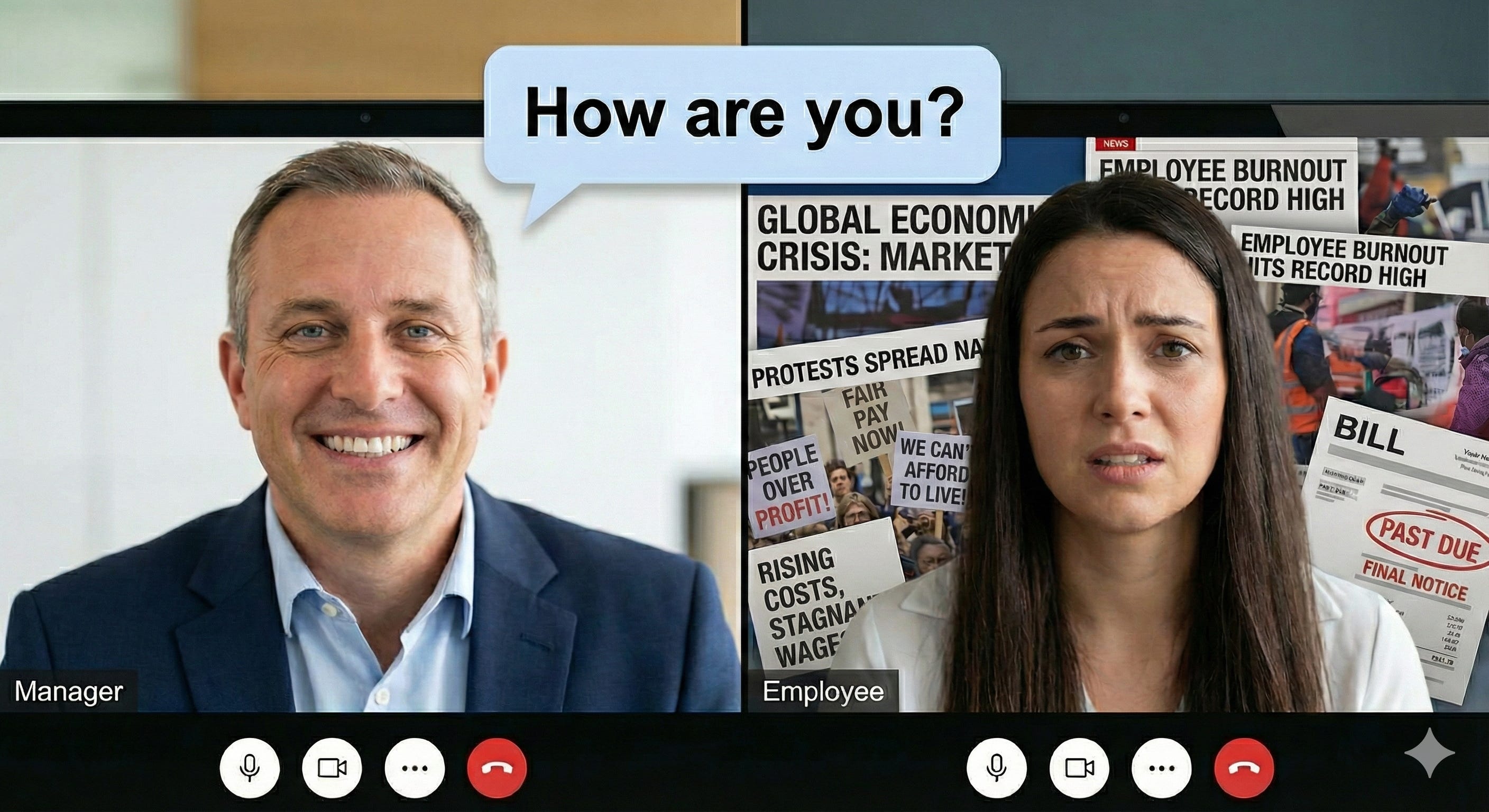
We are all guilty of the automatic opener. You jump on the Zoom call, the camera flickers on, and you say it out of habit:
“How are you?”
In calmer times, the answer is a social contract: “Good,” “Busy,” “Living the Dream,” or “Ready for the weekend.” We nod, we smile, we move to the agenda.
But this isn’t a normal year in calmer times. Right now, that question is a landmine.
When you ask “How are you?” to an employee whose spouse’s job with Amazon is in jeopardy, or who is watching ICE raids on the news and in their neighborhood, or who is staring at a grocery bill they can’t pay — you are inviting an answer most managers are terrified to hear.
The honest answer might be: “I’m not sleeping,” or “I’m terrified,” or “I don’t know if I can stay in this city.”
Most managers are not equipped to handle the “How are you” question honesty. They aren’t trained therapists. They don’t have solutions for inflation or government policy. So, when they get a real answer, they freeze. They offer a platitude (”It’ll be okay”) which feels dismissive, or they rush back to the spreadsheet, which feels cold.
This dynamic erodes trust exactly when you need it most.
Here is the reality: You do not need to be a therapist to be a good manager during a crisis. You just need better questions.
The Trap of “Toxic Positivity” vs. “Strategic Realism”
The biggest mistake leaders make right now is thinking they have to fix the feelings in the room to get the work done. You don’t.
We need to practice Strategic Realism.
Strategic Realism means acknowledging the external pressure without trying to resolve it. It draws a clear boundary:
Therapy is for processing deep emotion and trauma.
Management is for processing capacity and removing blockers.
Your goal in a 1-on-1 right now isn’t to make your employee feel “happy” or to put on a super hero cape, sweeping in to “save the day.” It is to help them function safely amidst the chaos. You are assessing their bandwidth, not their psyche.
The New Scripts: Specificity is Safety
When you ask a vague question (”How are you?”), you force the employee to do the emotional labor of deciding how much truth to tell you.
Do I lie and say I’m fine? Do I tell the truth and make it awkward?
When you ask a specific, capacity-focused question, you create a container that feels safe. You are telling them: I see the context, and I am here to help you navigate work within it.
Stop asking “How are you?” and try these three alternatives this week:
The Context-Aware Opener
Instead of pretending the world isn’t on fire, acknowledge the smoke.
The Script: “Given everything going on outside these walls this week, I know focus is hard to come by. What is the biggest hurdle to getting [Project X] done today, and can I remove it for you?”
Why it works: You validate the external stress (”Given everything going on...”) without asking them to explain their personal trauma. You pivot immediately to your role as a manager: removing obstacles and road blocks.
The Capacity Scale
Trauma and stress impact cognitive function. An employee who is usually a “10” might be operating at a “4” this week. That is a reality you need to plan for, not ignore.
The Script: “I know there’s a lot of noise in the news right now. On a scale of 1 to 10, what is your realistic bandwidth for deep creative work today? If it’s low, let’s reschedule the brainstorm and focus on admin tasks.”
Why it works: It gives them a professional shorthand to say “I’m struggling” without having to fall apart in your office. It allows you to adjust expectations before a deadline is missed.
The “Safe Harbor” Statement
Sometimes, the best question is a statement of stability.
The Script: “I don’t have answers for what’s happening, but I want to make sure this team feels stable. Do you have what you need from me to get through this week?”
Why it works: It reinforces that while the macro environment is unstable, the micro environment (the team) is secure.
What If They Do Open Up?
Even with better questions, an employee might break down. They might tell you they are scared.
If that happens, do not try to fix it. Do not say: “Don’t worry, it won’t be that bad.” You don’t know that.
Instead, use the Acknowledge and Pivot technique:
“Thank you for trusting me with that. I can’t imagine how heavy that weighs on you. Given that, do we need to adjust your workload for the next few days so you have some breathing room?”
Your Job is Clarity, Not Comfort
We are facing a time where the “personal” and the “professional” are colliding violently. You cannot protect your team from the world. But you can protect their ability to succeed at their jobs despite the world.
Change your questions. acknowledging the reality, and focus on the work. That is the most empathetic thing you can do.