


I see this scenario play out with clients constantly, especially those headquartered outside of California.
The Scenario:
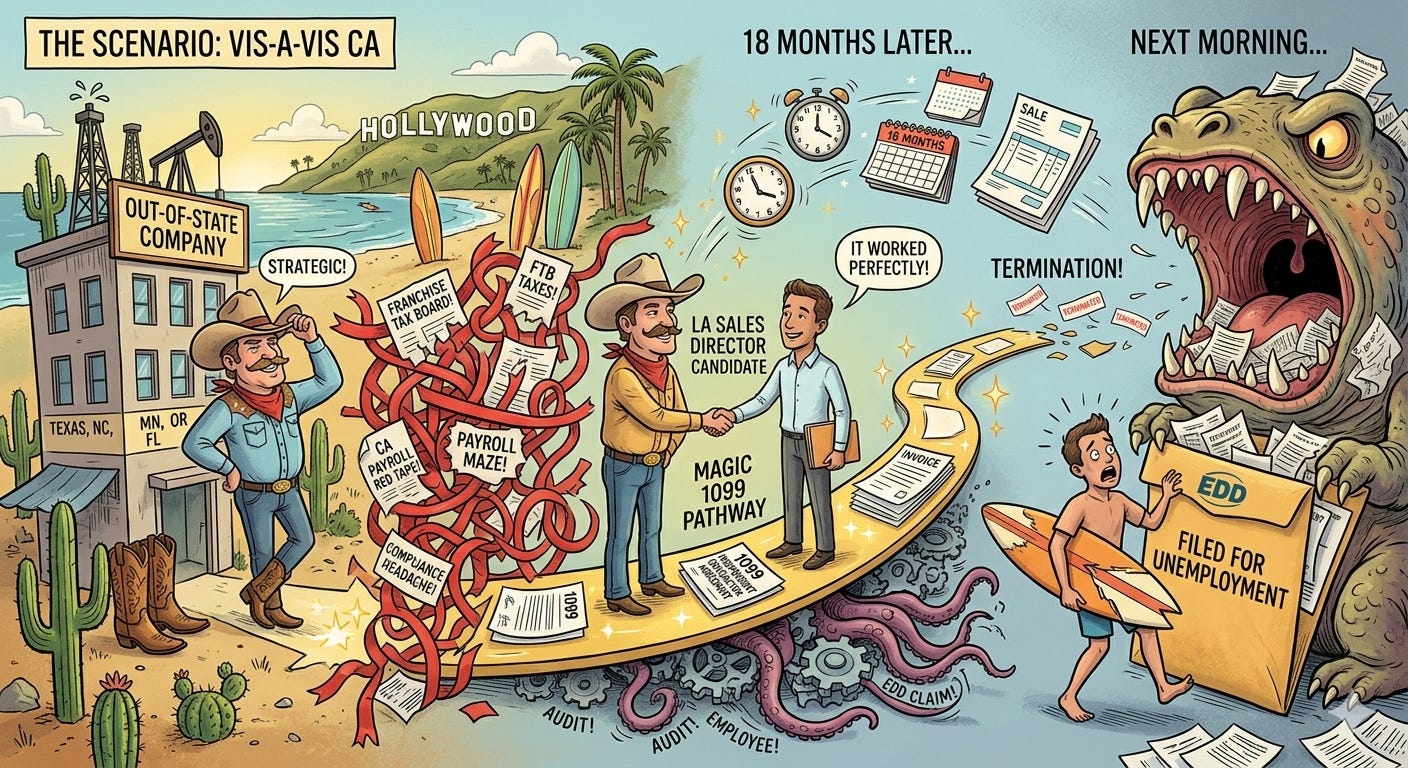
A company in Texas (or North Carolina, Minnesota, or Florida) wants to hire a Sales Director to cover the West Coast. They find a great candidate living in Los Angeles.
But the company doesn’t have a registered entity in California. They don’t want to deal with the Franchise Tax Board, the complex payroll laws, or the sheer headache of California compliance. Totally relatable, right?
So they make a “Strategic” decision:
“Let’s just hire them as a 1099 Independent Contractor. We’ll pay them a flat monthly retainer plus commission. They can handle their own taxes. It’s cleaner for everyone.”
For 18 months, it works perfectly. Invoices are paid. Sales are made. The company feels smart for avoiding the red tape and doesn’t give it another thought.
Then, the relationship changes and the Sales Director is terminated. Could be a termination for cause; could be a layoff or job elimination.
And the next morning, that “Independent Contractor” does what every employee does when they lose a job: They file for Unemployment.
The EDD “Red Flag” That Burns Down the House
No big deal, right? Not so fast. Let’s look at how this gets so out of control so fast.
The worker files a claim with the California Employment Development Department (EDD) listing your company as their last employer.
The EDD sends a “Notice of Wages” letter to your HQ. (Warning: Your mailroom often ignores this because “we don’t have employees in CA.” That is your first fatal mistake.)
The EDD looks up your Federal Employer Identification Number (FEIN).
Red Flag: They see zero accounts registered for you. You have never paid a dime of Unemployment Insurance (UI) or State Disability Insurance (SDI) in California.
To the EDD, you aren’t an out-of-state company that made a mistake. You are a “Non-Registrant.” You are a ghost employer operating in their state without paying taxes.
They don’t just send you a letter asking for the UI money.
They launch a full-scale forensic audit.
The Real Cost of “Avoiding the Hassle”
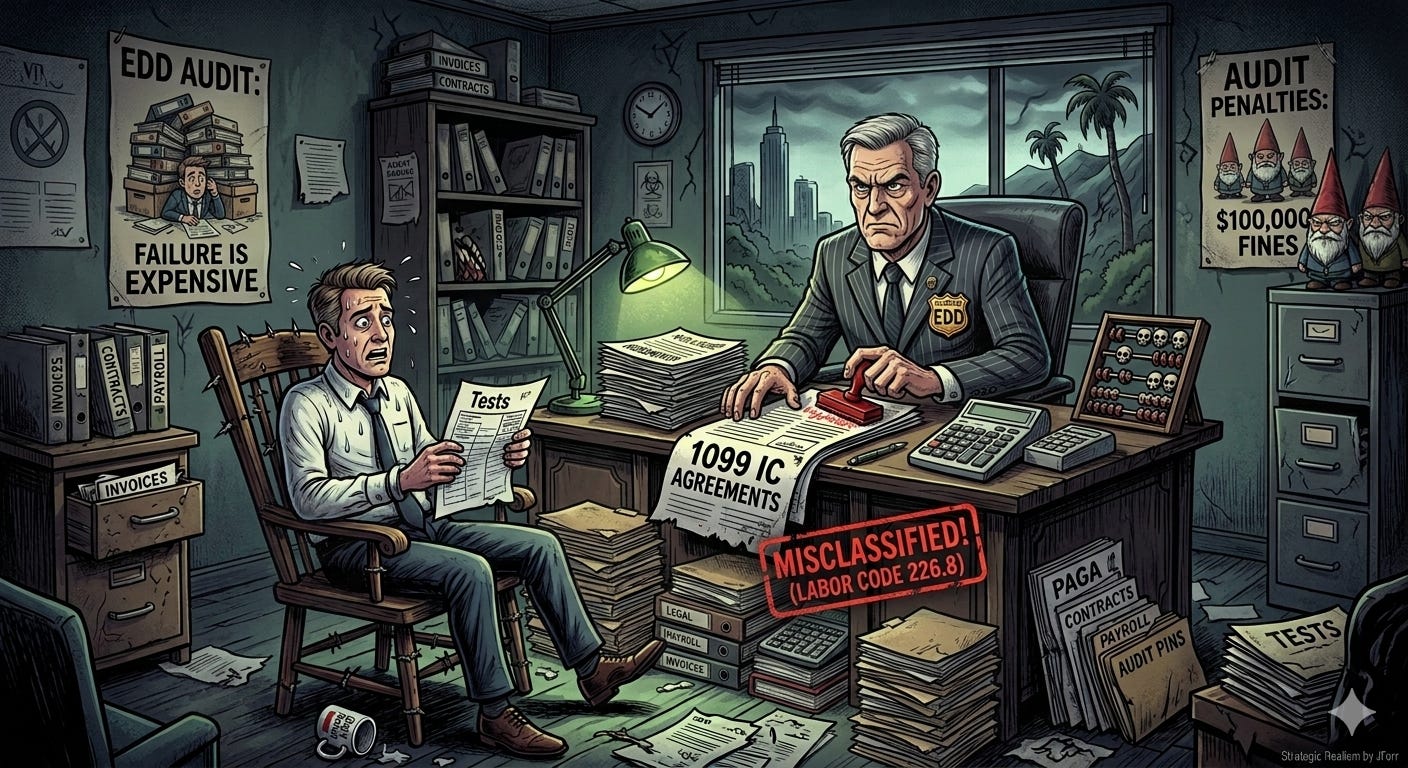
When the EDD audits you for IC misclassification, they don’t just look at that one Sales Director. They look at everyone you paid in California for the last 3 years.
And because you never registered, you have zero defense. Hope you’re sitting down; here is the bill you are about to receive:
The Back Taxes (You Pay Double)
Since you didn’t withhold taxes from their paycheck, the state holds you responsible for them.
State Income Tax (PIT): You pay what you should have withheld. (Unless you can get the person you just fired to sign an affidavit proving they paid their own taxes — good luck with that.)
State Disability (SDI): You pay the employee’s share.
Unemployment (UI) & Training Tax (ETT): You pay the employer share.
The “Failure to File” Penalties
Because you never filed a payroll return (DE 9), you get hit with:
15% Penalty for failure to pay.
Another 15% Penalty if you didn’t file within 60 days of the due date, plus administrative fines that often exceed $1,300 per employee depending on the timeline.
Interest: Compounded daily on the unpaid balance.
The “Willful Misclassification” Fine (The Kicker)
Under California Labor Code § 226.8, if the state decides you “willfully” misclassified them to avoid tax liability (which is exactly what you did), they can fine you between $5,000 and $25,000 per violation.
The Personal Liability
This is the part that makes CFOs and CHROs sweat.
Under Section 1735 of the UI Code, if a corporation fails to pay these payroll taxes, the EDD can pierce the corporate veil and hold owners and officers personally liable for the debt. That means they can come after your personal bank account to satisfy the tax bill.
Strategic Realism: The Math Doesn’t Work
Let’s say you paid that Sales Director $150,000 a year.
Cost of Compliance: Using a simplified payroll service or Employer of Record (EOR) would have cost you maybe $20,000 in taxes and fees.
Cost of the Gamble: Between back taxes, penalties, interest, and legal fees to fight the audit, that “Contractor” decision can easily cost you $100,000+ in unrecoverable fines.
The “Safe” Way to Hire in California
If you are an out-of-state company, you have two safe options:
Register as an Employer: Bite the bullet. Register with the EDD and the Secretary of State. Pay the taxes.
Use an Employer of Record (EOR): If you don’t want the nexus, hire a third-party EOR (like Deel, Remote, or a PEO) to legally employ the person. They take the liability. They handle the compliance.
Do not try to “1099” your way out of California.
The state has entire divisions dedicated to finding you. And all it takes is one unhappy or uninformed sales rep filing a web form to bring them to your door.
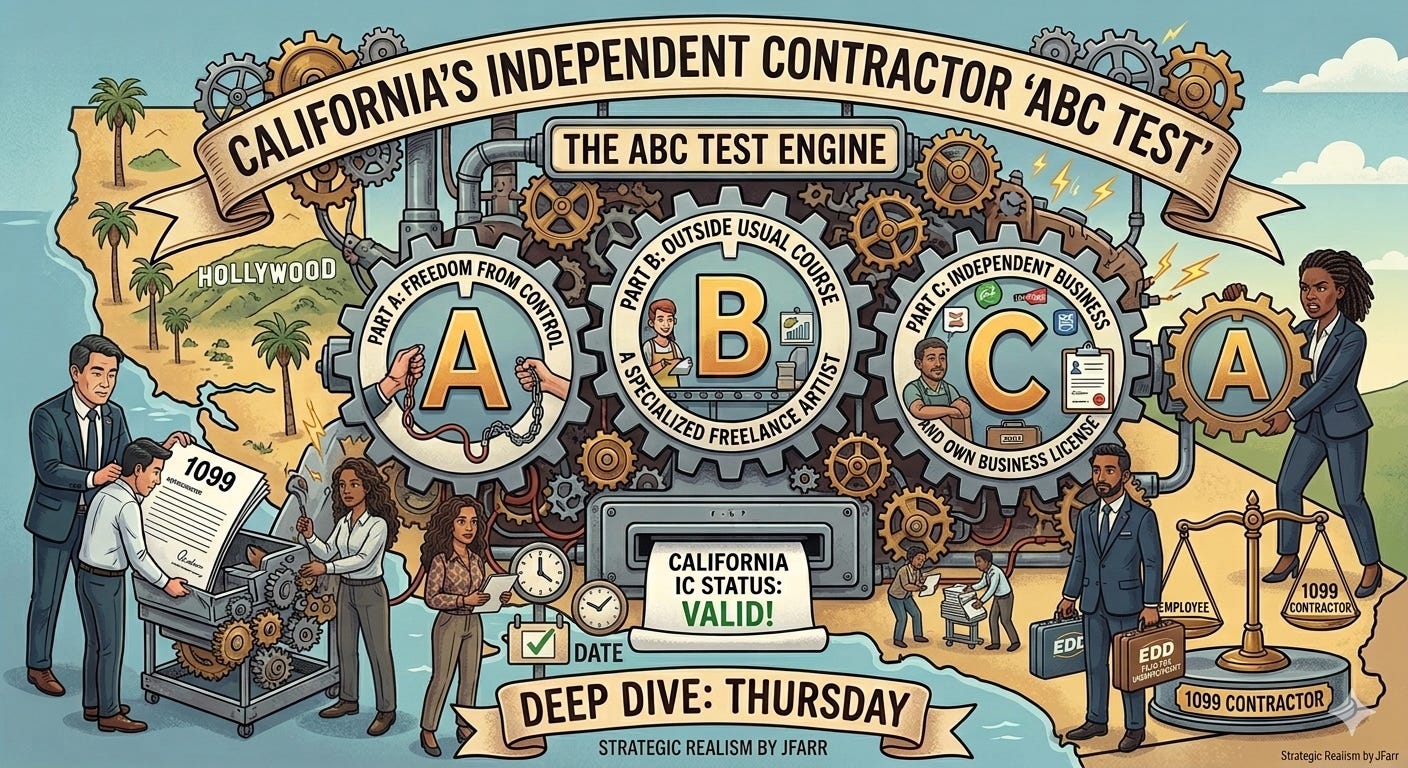
COMING THURSDAY: California’s Independent Contractor “ABC Test” Deep Dive
Are you sweating yet? You should be.
If you are wondering, “Wait, how do I actually know if my contractors are legal?” we have you covered.
This Thursday, we are dropping the Ultimate Guide to the California ABC Test.
We will break down the three strict rules every California employer must follow, expose the “Business-to-Business” loophole that most people get wrong, and give you a simple checklist to audit your own team before the EDD does. Subscribe now so you don’t miss it.
Need a Risk Assessment Today?
Can’t wait until Thursday? If you are an out-of-state employer with 1099 “Contractors” in California right now, you might be sitting on a ticking time bomb. We can help you conduct a confidential 1099 Risk Audit and transition your workforce to safety before the EDD gets involved.
