


If Tuesday’s post was about weatherproofing your building, today is about your insurance policy.
In California, PAGA (Private Attorneys General Act) has historically been the “superstorm” that leveled businesses. It allowed a single disgruntled employee to sue on behalf of the entire state for every minor technicality in your handbook and payroll practices.
But as we are about to slide into Q2 2026, the rules have fundamentally shifted. We finally have a Pressure Relief Valve. The catch? It only works if you turn it before the notice arrives.
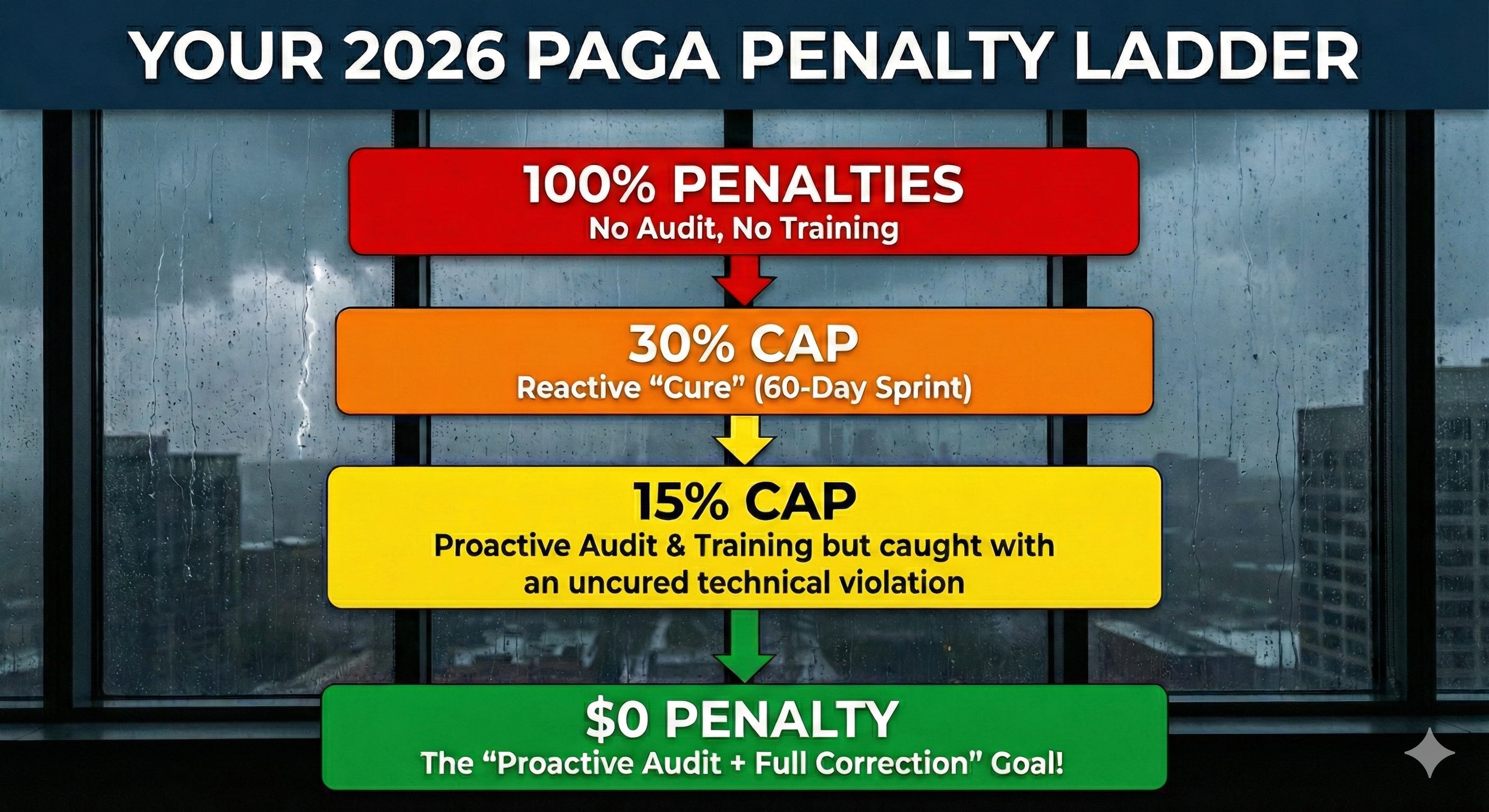
The 15% Cap: The Reward for “Reasonable Steps”
Under the 2026 reforms, the state has given us a clear financial incentive for being proactive. If you can prove you took “All Reasonable Steps” to comply before receiving a PAGA notice, your penalty exposure is capped at a staggering 15%.
Think about that ROI. An unmitigated PAGA claim that might have cost you $1M in penalties is suddenly capped at $150k. That could be the difference between a bad quarter and a closed business.
The Path to Zero Penalty
Here is the ultimate goal: If you take those reasonable steps AND fully cure the violation before a PAGA notice arrives (like after receiving an internal employee complaint), the penalty doesn’t just drop to 15%—it can be eliminated entirely.
You aren’t just reducing a fine; you’re removing the target from your back. This is why the Corrective Action step is the most critical part of any audit. If you find a leak, you must fix it immediately and document the repair.
What counts as a “Reasonable Step” in 2026?
The LWDA isn’t looking for “best efforts.” They are looking for a repeatable, documented compliance system:
Periodic Payroll Audits: Documented spot-checks of timecards vs. pay stubs to catch rounding errors or missed premiums.
Supervisor Training: You must prove managers were trained on California-specific meal/rest break and overtime laws (keep those attendance logs!).
Disseminated Policies: Lawful written policies that reflect the 2026 legislative shifts.
Corrective Action: If you find a “leak” during an audit, you must document exactly how you fixed it.
The “Right to Cure”: Your 60-Day Sprint
If a PAGA notice hits your desk tomorrow and you haven’t audited your files yet, you aren’t underwater yet, but you’re treading.
You now have a 60-day window to take “all reasonable steps” to prospectively comply and “cure” the violation (making employees whole). If you do this within the window, your penalties are capped at 30%. It’s more expensive than being proactive, but it’s still 70% better than the alternative.
Crucial Detail: The reform specifically requires
that you take steps to be prospectively in compliance within those 60 days. It’s not just about paying for the past (making them whole); it’s about proving to the LWDA that the “leak” is fixed for the future.
Level Up: Since standing rules tightened in 2026, plaintiffs must have personally experienced the violation within the last year. This narrows the field and gives you a smaller target to ‘cure’ during that 60-day sprint.
The “Cure” Checklist:
Make Employees Whole: Pay all unpaid wages plus 7% interest and any liquidated damages required by law, going back three years.
Fix the System: Prove the underlying policy that caused the leak has been permanently repaired.
Small Business Bonus: If you have fewer than 100 employees, you have an expanded right to a confidential “Cure Proposal” process through the LWDA to resolve things before they ever hit a courtroom.
The Realist Bottom Line
A PAGA audit isn’t a “luxury” expense. It is a high-limit insurance policy. If you wait until the process server is at your door, you’ve already lost the 15% cap.
Is your audit trail ready for a 15% cap?
Don’t leave your structural integrity to chance. Let’s look at your payroll and training logs now, before the state does it for you.
Book your PAGA Readiness Audit here: JFarrHR
