


If you follow the theater (or pop music) world, you probably saw the recent news: Grammy-winning rapper and pop superstar Megan Thee Stallion stepped into a demanding role in Moulin Rouge! on Broadway, and ended up hospitalized from exhaustion.

The Sprint vs. The Ultramarathon
Let me be incredibly clear: this is not a knock on Megan or touring pop and rock stars. I’ve played in bands and stood on those stages too. Touring is exhausting, and rock stars absolutely face burnout if they don’t prioritize their recovery. But there is a structural difference. With traditional rock concert tours, rest and off-days are usually built into the project plan. You perform a few nights a week, you travel, and you recover.
Broadway is an ultramarathon run at a sprint pace. It’s eight shows a week. It’s double-shift days with matinees. It is three to six hours of grueling, high-stakes performance every single day, with the remaining time eaten up by rehearsals, vocal rest, and sudden run-throughs when a cast member calls out sick.
And if you want to talk about the absolute worst of both worlds, look at the performers on regional Broadway tours. They are running that exact same 8-show-a-week gauntlet, but every week or two, they are packing up and moving to a new city. The travel often happens overnight right after the final Sunday performance. There are no real “days off” built in, they are living out of suitcases, and these tours can last for years. The exhaustion factor is massively amplified.
Protecting the Instrument
As a triple-threat stage performer myself, I know firsthand that theater actors don’t just sing and dance — they train, study, and survive like elite athletes. I’ve lived a (much) smaller version of this. In my last stage role, we only performed six shows a week (two shows a day over three days). By the time the production closed, I had lost 20 pounds from the sheer physical exertion of tap dancing for two hours straight. And I was in the best shape of my life.
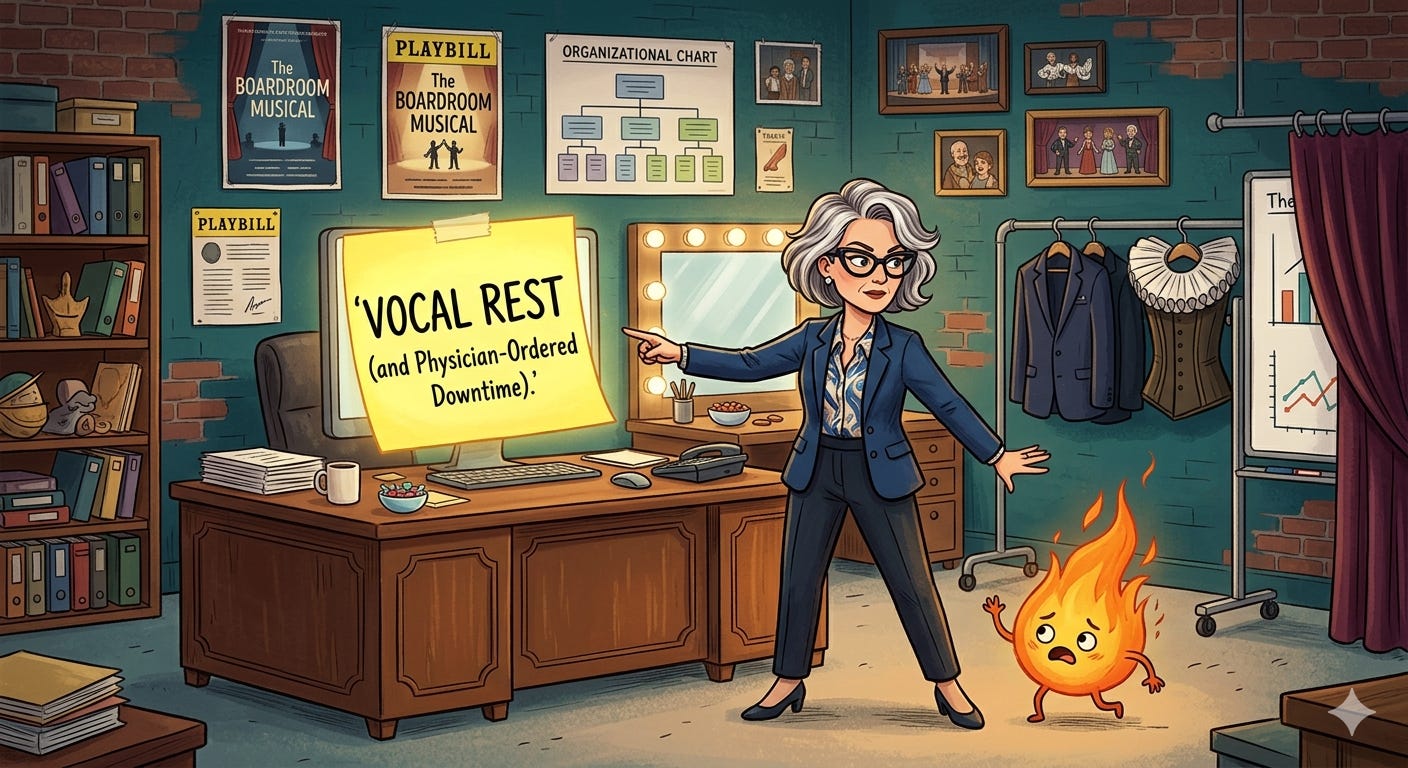
To survive that pace, an actor must aggressively protect their body, their voice, and their sanity. On a recent trip to NYC, I stage-doored after seeing the legendary Jinkx Monsoon perform. Jinkx came out to greet fans wearing a Post-it note stuck to their chest that simply read: “Vocal Rest.” It was physician-ordered. Because eight shows a week will cripple even the most seasoned, brilliant performer if they don’t guard their recovery.
Now that Megan is out of the hospital and reflecting, she has candidly admitted she wasn’t truly aware of the physical and mental strain of the Broadway stage, and wasn’t caring for herself in the right way to sustain it.
The Corporate Casting Mistake
I have sadly learned this exact same lesson off-stage, sitting in an ergonomic chair. I’ve lived those insane 14-to-16-hour HR leader days, chained to a computer, running from one endless corporate fire to the next until my body forced me to stop. The burnout happens exactly the same way.
In my two decades of HR leadership, I see companies make this exact “casting” mistake every single day. Leaders get blinded by a flashy resume, hire a ‘rockstar,’ and then watch them completely crash out because they didn’t vet them for the actual pace of the production — and they didn’t build a system to support them once they got there.
Here is how to stop casting for the show’s theatrical poster, and start building a resilient cast that can survive your 8-shows-a-week reality.
Vetting for Stamina, Not Just Stardom
You have likely interviewed the candidate who claims they have “stage experience.” Their resume is stacked. But when they hit the office floor, they completely crumble under the volume of work.

Why? Because during the interview process, the hiring manager didn’t dig into the context of their experience. Yes, they were in a stage production — but it turns out they played a Tree in their elementary school production of Much Ado About Nothing, or they did a five-minute comedy skit at a previous company offsite.
When interviewing, you have to vet for the realities of your specific stage. Ask behavioral questions that test their stamina. “Tell me about a time you had to deliver high-quality work during our industry’s busy season, day after day, without dropping the ball. How did you manage your energy?” Don’t just ask if they can sing the song; ask if they can sing it on a Wednesday matinee after a brutal Tuesday night shift.
A quick legal check-in: vetting for stamina does not mean asking candidates about their physical or mental health — that is a fast track to an ADA violation. You are vetting their workload management and resilience. Ask them to give you examples of how they’ve prioritized competing deadlines in past roles, or how they communicated when a project started going off the rails.
The Hostage Situation (When the Star Gets Sick)
Let’s say leadership does hire a rockstar, and that person is carrying the entire weight of the department. What happens when they get the flu an hour before the curtain goes up? What happens when they put in their two weeks’ notice?
If an organization falls apart because one person goes on vacation or quits, that isn’t a business. It’s a hostage situation.
Too many companies allow knowledge hoarding to masquerade as job security. The top performer refuses to train anyone else on their processes, and leadership lets them get away with it because they are terrified of upsetting the talent. But in theater, the show must go on. If the lead is out, the show doesn’t cancel. The understudy steps in, hits their marks, and the audience still gets a world-class performance.
Build Your Bench with “Swings”
The hardest working, most talented people on a Broadway stage are often the ones whose names aren’t on the marquee: The Swings. A swing is a performer who memorizes the lines, choreography, and blocking for multiple roles, ready to step into any track at a moment’s notice.
In the corporate world, this is cross-training, and it is the ultimate risk-mitigation strategy.

Leaders need to identify the single points of failure in their organization and build their bench strength. Require top performers to document their processes. Rotate team members through different responsibilities.
And here is the Strategic Realism catch: You have to reward your swings. On Broadway, swings are highly respected and compensated for their versatility. In corporate America, the agile employee who can seamlessly cover payroll, jump into a client pitch, or troubleshoot operations usually just gets rewarded with burnout and no extra pay. If you want a resilient cast, compensate the people who keep the show running when things go wrong.
Playbill Notes: The Strategic Realism Drop
It’s critical to talk about the legal and operational liability of the “Hostage Situation.” If your entire compliance protocol, payroll process, or client data management lives exclusively inside the head of one employee, you are operating with massive, unmitigated risk. Standard Operating Procedures (SOPs) aren’t just bureaucratic paperwork; they are your understudy’s script. If you don’t have the script written down, no one can step in to save the show.
But you cannot ask a burned-out rockstar doing eight shows a week to write the script between acts. You have to give them the operational space to do it. Assign a junior team member to shadow them and take the notes, or dedicate one afternoon a week where they are completely offline specifically to build out those SOPs.
The Sweet Sound of Strategic Realism
Stop building your business around the fragile hope that your lead actor will never get sick, burn out, or take a better gig across town.
Hiring great talent is only step one. Step two is building a culture of cross-training and shared knowledge so that when the star inevitably exits stage left, the show effortlessly goes on.
The Track of the Week
🎵 “Non-Stop” from Hamilton 🎵
Why it fits: Aside from being a masterpiece of musical theater, this track perfectly encapsulates the relentless, exhausting, unstoppable grind of building something great. It’s about the sheer stamina required to write the Federalist Papers, but it might as well be the anthem for the 8-show Broadway week. Stardom gets you in the door, but stamina keeps you on the stage.
Over to you
Look at your current team. If your absolute top performer called out sick for two weeks starting tomorrow, would the show go on, or would you have to issue refunds? Let me know in the comments where you need to start cross-training.
And if you just realized your entire business is one bad flu away from a hostage situation, let’s talk. I run operational assessments to identify these exact single points of failure and build the playbook to fix them. Reach out and let’s get your bench ready.
