


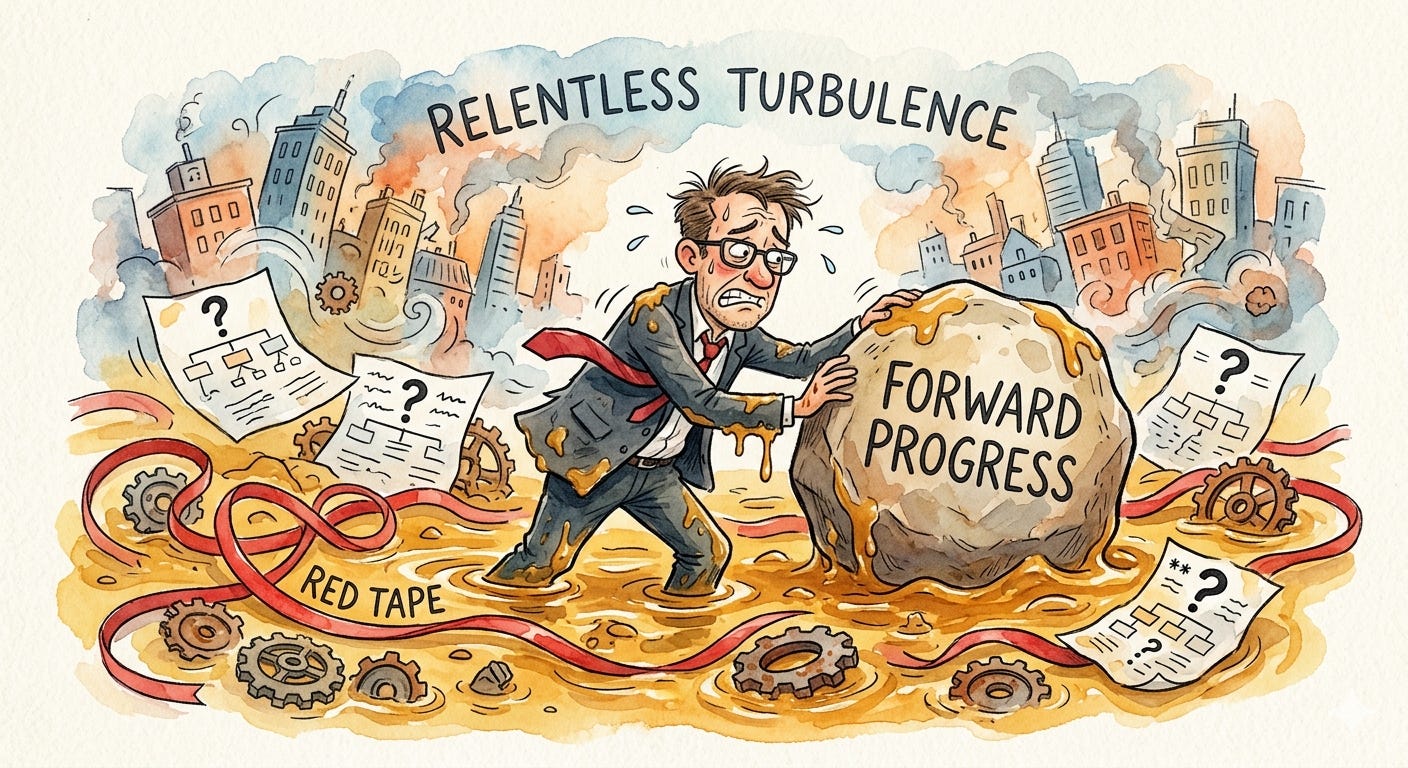
We are operating in an era of relentless turbulence. Between the lingering economic shifts of the past five+ years, volatile funding streams, and global instability, organizations are feeling the squeeze.
As a result, a common theme is emerging in my conversations with executives across multiple industries: they feel stuck. Whether you are a tenured executive who feels like you’ve been spinning your wheels for months (years?) without making forward progress, or an interim or incoming leader brought in to stabilize a rocky transition, the feeling is the same. The vision is there, the intent is there, but the day-to-day reality is dominated by friction, bottlenecks, and exhaustion.
When a good leader hits a wall, the instinct is often to work harder, push faster, or question their own capabilities. But in my experience, a leadership standstill is rarely a failure of leadership. It is almost always a failure of the ecosystem around them.
When organizations are pressured by external forces — like tightening budgets or shifting grant requirements — the internal cracks in the foundation begin to widen. Good leaders get stuck because they are forced to navigate:
Misaligned Structures: The organizational chart that worked in 2019 might be actively working against you today. Reporting lines get tangled, decision-making becomes decentralized in the wrong ways, and accountability evaporates.
Outdated Processes: When external pressures rise, organizations often slap band-aids on broken processes. Over time, these workarounds become the rule, creating massive bottlenecks that slow down every initiative you try to launch.
System Disconnects: If your technology, communication channels, and operational systems aren’t talking to each other, your people can’t either. This creates silos where information (and progress) goes to die.
People in the Wrong Seats: Sometimes, the friction comes from a team that is burned out, misaligned with the current mission, or lacking the specific skill set or support they need to execute your vision.
How to Unstick the Organization
You cannot fix a system while you are trapped inside of it. When friction dominates the workplace and progress stalls, the most strategic move a leader can make is to pause and take stock.
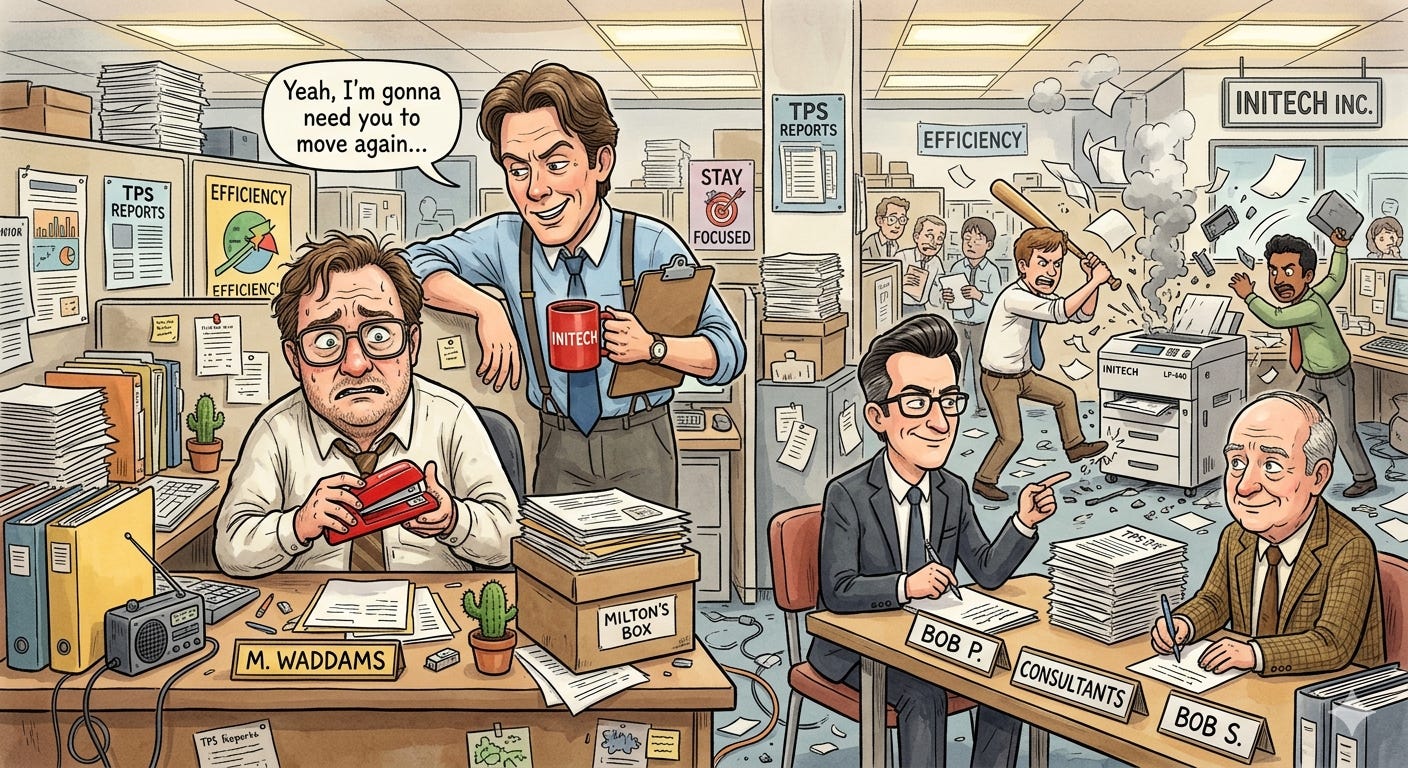
This is where a comprehensive Operational & HR Assessment becomes invaluable. It is not an audit to assign blame conducted by Bill and “The Bobs” from Office Space; it is a diagnostic tool to map the friction. By bringing in an objective partner to evaluate your structure, people, processes, and systems, you can finally identify exactly where the gaps are. (And a good consultant will figure out quickly that Milton is still in the basement, unpaid.)
Stop trying to push through the molasses. Take a step back, assess the foundation, and rebuild a framework that actually supports your vision — and your team.
What Actually Happens During an Assessment? (And Why You Need One)
When I propose an Operational & HR Assessment, the immediate reaction is often a mix of relief and hesitation. Leaders want the fix, but they worry about the disruption.
Let’s clear the air: an assessment is not a witch hunt. It is a structured process of documenting reality. We look at four critical data points for every role:
What the person is expected to do.
What the person is required to do.
What the person knows how to do.
What the person is actually doing every day.
When those four things don’t align, you get friction. An assessment brings that misalignment into the light. It allows leaders to structure the organization to suit its specific, current needs, rather than relying on a ghost structure from five years ago.
And a comprehensive assessment isn’t a never-ending consulting gig; it is a swift, 6-8 week process designed to minimize interruption to your team and the daily operations.
The Investment Fallacy: Can’t I Just Hire My Way Out of This?
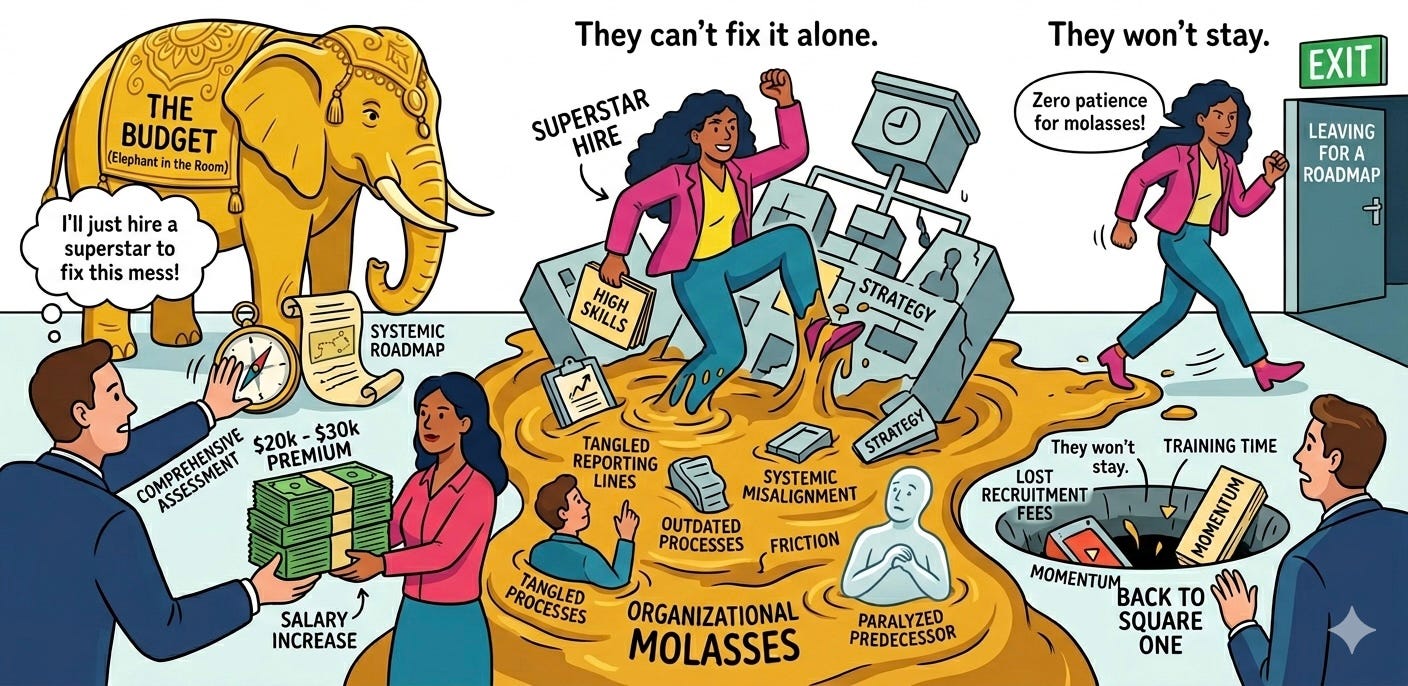
Let’s talk about the elephant in the room: the budget. For a nonprofit or a smaller organization where every dollar is spoken for, a comprehensive assessment is a significant investment.
Often, a leader will look at the cost of an assessment — which might be roughly equivalent to giving a key manager a 10-20% salary increase, or hiring a new director at a $20k – $30k premium — and think: “I’ll just hire someone more expensive. If I pay for a higher skill set, they’ll come in and magically unstick this mess so I can finally get back to my actual work.”
It is a logical thought, but it’s a dangerous one.
When you bring high-level talent or a “superstar” hire into a broken environment dominated by friction and systemic misalignment, two things happen:
They can’t fix it alone. No matter how talented they are, they are still operating within the same tangled reporting lines and outdated processes that paralyzed their predecessor.
They won’t stay. High performers have zero patience for “molasses.” If they realize they’ve been hired into a “broken house” with no roadmap for repair, they will take those expensive skills elsewhere within six months.
Now, you’re back to square one, but you’ve lost the recruitment fees, the training time, and the momentum.
The ROI of a Roadmap
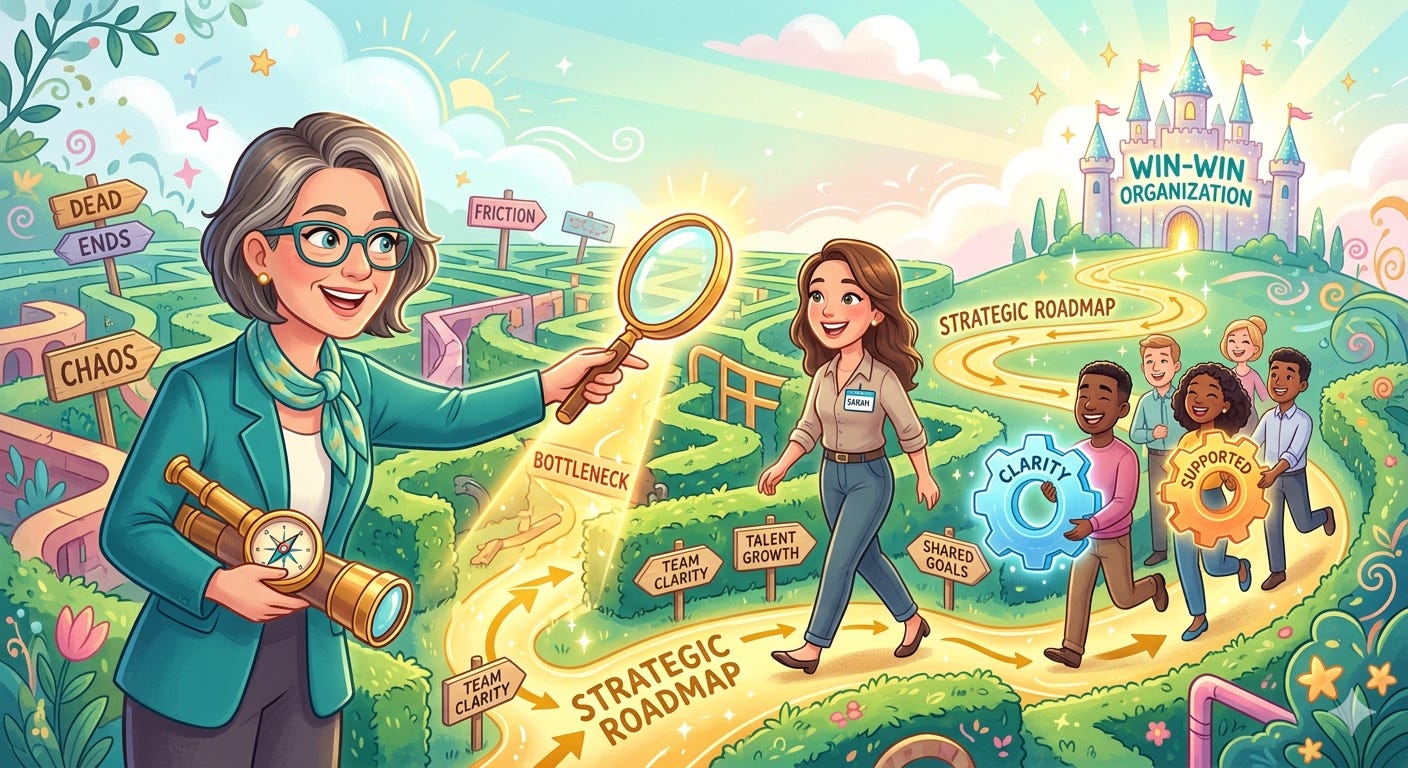
An assessment isn’t just a list of what’s wrong; it’s a strategic roadmap. It provides objective data points that take the “guesswork” out of leadership. Instead of making decisions based on who is complaining the loudest or which department feels the most “on fire,” you can make win-win decisions based on facts.
When you align your structure to your current mission, the “lost money” from friction — the hours spent in redundant meetings, the turnover costs, the missed grant opportunities because the team was too buried in busy-work to execute or follow-up — starts flowing back into the organization.
The investment in an assessment benefits everyone:
The Leader: You get your time and your vision back.
The Staff: They get clarity and a “clean plate.”
The Community/Clients: They get the full impact of an organization that is finally moving forward again.
Managing the Fear Factor
I won’t sugarcoat it: announcing an HR or Operational assessment right now is going to make your staff nervous. We are operating in an environment where major tech giants like Oracle are laying off 30,000 employees at 6:00 a.m. via email. Job security is top of mind for everyone.
As a leader, you must frame this assessment as what it truly is: a direct investment in your staff and the organization — a tool for stability, not reduction.
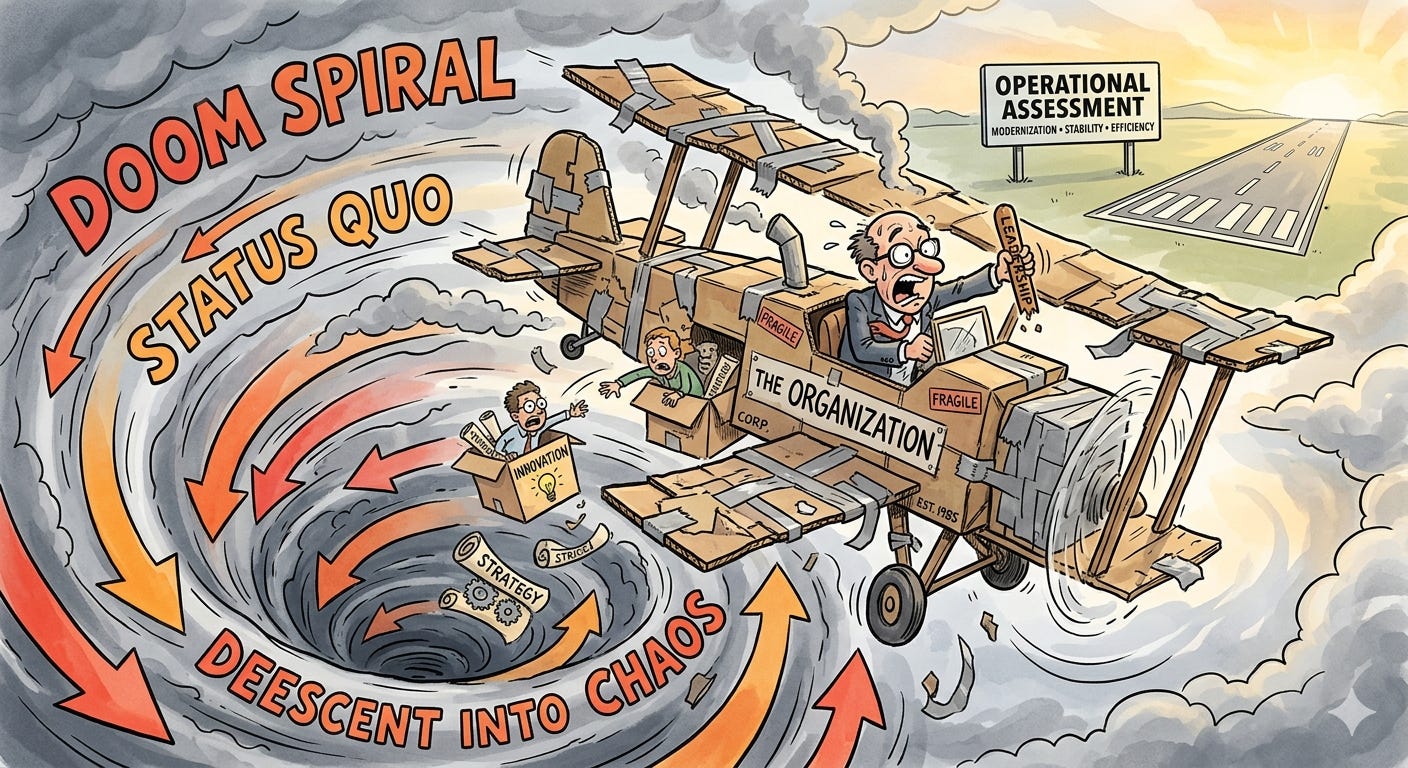
Imagine the alternative: maintaining the status quo. If the organization remains stuck and growth stalls while inflation rises and everyday costs skyrocket, a deficit becomes inevitable. Eventually, to make up for that shortfall in revenue or operational costs, leadership is forced to make painful cuts. That usually means reducing headcount, forcing an already fractured and exhausted team to do “more with even less.” Left unchecked, this doom spiral can eventually cause the entire organization to fold, leaving everyone out of work.
An assessment stops the doom spiral. It allows leadership to step back and figure out how to make the best, most sustainable use of all resources — human and otherwise — to ensure everyone succeeds.
Ultimately, comparing expectations against reality is about streamlining everyone’s workload. We want to cut the noise by killing outdated processes, canceling pointless meetings, and closing the system and skill gaps that slow people down. A well-executed assessment provides a clear roadmap for leadership, while finally giving the staff the relief and support they’ve been longing for.
Want to Test the Waters? Try a “Mini-Audit”
If you aren’t ready to pull the trigger on a full organizational assessment, you can pilot the concept within a single, highly bottlenecked department. Here is a quick framework:
The “Stop Doing” List: Ask every team member to anonymously submit one task they do weekly that they believe adds zero value to the organization.
The Process Map: Pick the one process that causes the most complaints. Map it out on a whiteboard, step-by-step. You will almost always find a loop where things get stuck for days.
The Tool Check: Ask the team: “Are our current software/systems making your job easier, or are you creating workarounds just to use them?”
A mini-audit will quickly show you the gap between the leadership view and the frontline reality.
Don’t Stay Stuck
You don’t have to navigate this turbulence blind. If your organization is stalled, it is time to stop pushing harder and start looking deeper.
If you are ready to identify your bottlenecks, clear your team’s plates, and get your business moving forward again, let’s talk. Reply directly to this email or click on the Message JFarrHR button below to book a 20-minute discovery call to see if an assessment is the right next step for your organization.
