


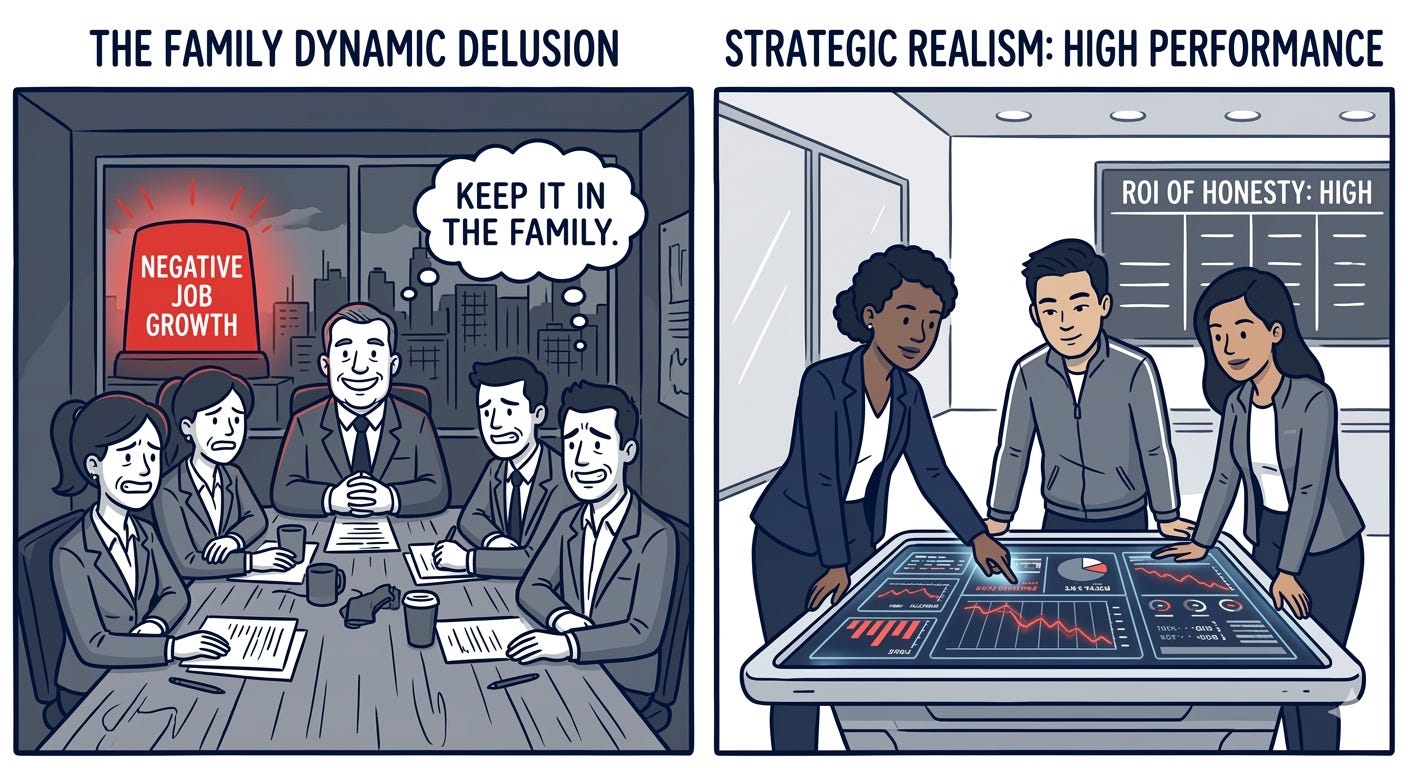
There is a slow-moving crisis in modern leadership, and it isn’t just a lack of talent or a shifting market. It is a profound lack of intellectual honesty.
We are operating in an environment of deep anxiety. The Department of Labor recently revised last year’s job numbers significantly downward, we are seeing months with negative job growth, and major employers are continuing to lay off highly talented, skilled workers.
In a “post-truth” society — where algorithms feed us comfortable echo chambers and reality feels increasingly subjective — the workplace used to be the one place where math mattered. But under extreme economic pressure, many leaders retreat into delusion. Instead of facing the brutal facts of the market (which they can’t control), they try to control the narrative (much easier to control).
And the most dangerous tool they use to control that narrative is telling their employees, “We are a Family.”
The Toxicity of the “Family” Culture
When a leader or organization says, “We are a family here,” it sounds comforting. But see it for what it is. In practice, it is often a mechanism for control. Healthy families offer unconditional love; dysfunctional corporate families demand unconditional loyalty. They expect you to sacrifice your professional boundaries for the group, and most importantly, they demand that you keep the “dirty laundry” in the house.
In these environments, the organization’s primary goal is no longer operational excellence; it is the protection of the leader’s ego and the illusion of harmony. Therefore, when an employee exercises intellectual honesty — perhaps by pointing out a critical operational failure, documenting a manager’s toxic behavior, or warning about a looming financial cliff — they are not viewed as a professional trying to solve a problem. They are viewed as a threat to the family.
This triggers one of the most destructive and legally dangerous dynamics in the modern workplace: Scapegoating.
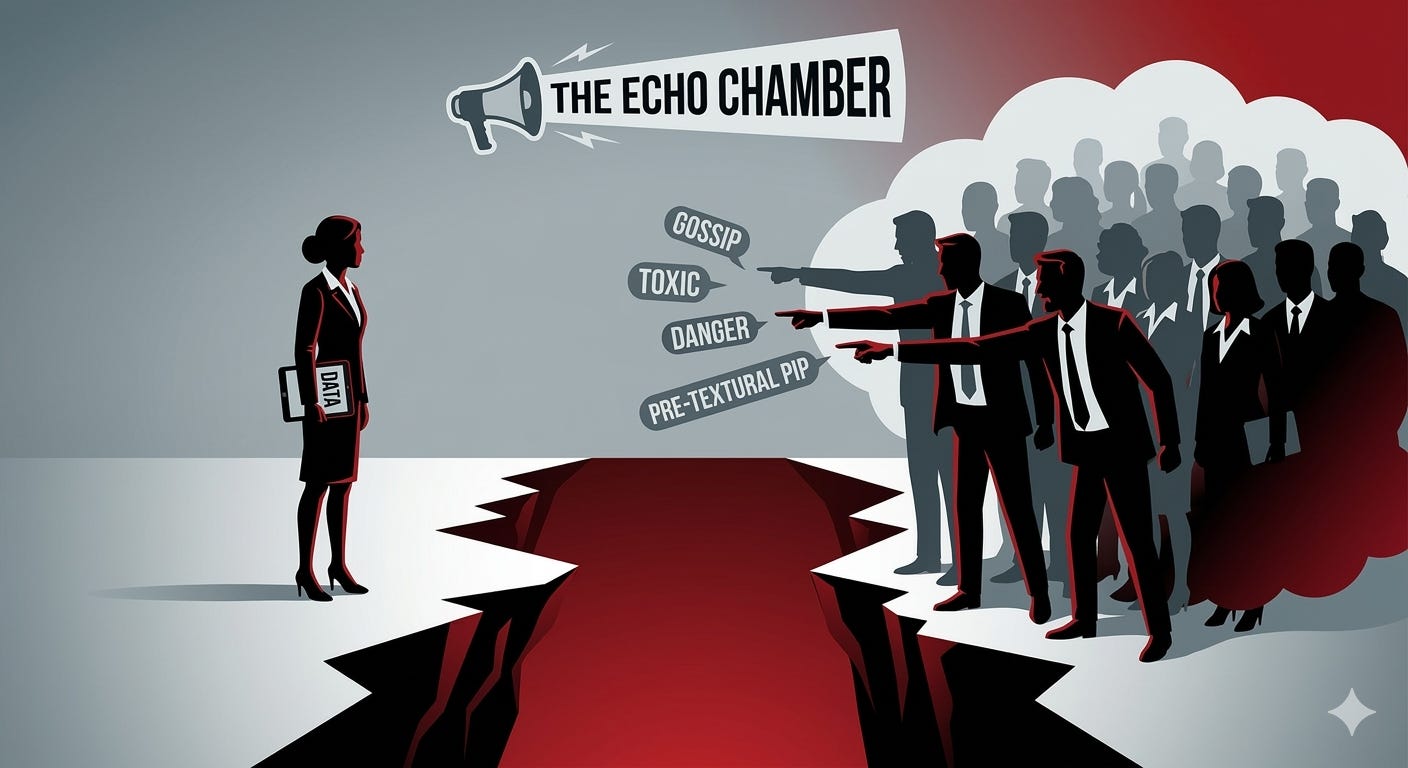
The Scapegoat Mechanism
Scapegoating in a corporate “Family” is a predictable process designed to neutralize the person exposing the dysfunction:
The Violation: The truth-teller breaks the unspoken rule of toxic positivity. They might go outside the direct chain of command because their immediate manager is the problem, or they present data that contradicts leadership’s preferred narrative.
The Shift in Focus: Instead of addressing the critical issue the employee raised, leadership shifts the entire focus onto how the employee raised it. The employee’s “tone,” “attitude,” or “insubordination” becomes the manufactured crisis.
The Isolation: The truth-teller is systematically and subtly marginalized. They are left off critical meeting invites, subjected to sudden and intense micromanagement, and labeled as “toxic,” “difficult,” or “not a team player.” But the isolation rarely stops at management. Toxic leaders will actively infect the rest of the “family” by gossiping and manipulating how the team views the truth-teller. Work assignments and high-visibility opportunities are quietly diverted away from them. Ultimately, the toxic leader converts peers and other staff members into “flying monkeys,” weaponizing the team to dramatically scale the emotional abuse, isolate the target completely, and force the person out of the organization.
The Purge: If the isolation and scaled abuse are unsuccessful in forcing the scapegoat to quit, the organization initiates the final phase: the paper trail. Management suddenly weaponizes coaching sessions and performance reviews, suddenly finding fault in work that was previously praised, or places the employee on a rigid, impossible-to-pass Performance Improvement Plan (PIP). The organization builds a pretextual case to formally remove the employee, essentially sacrificing them to restore the artificial harmony of the echo chamber.
During all this, the leader convinces themselves they are just removing a “bad cultural fit.” In reality, they are shooting the messenger to protect the dysfunction.
The Legal Reality: A Liability Multiplier
From an HR perspective, scapegoating a truth-teller isn’t only bad management; it is a massive liability.
Both federal and state laws aggressively protect employees who engage in “protected activities.” If the truth-teller was exposing something legally problematic (wage theft, harassment, financial irregularities) and the company responds by isolating or firing them for “disrupting the family,” that is textbook retaliation.
This is especially dangerous in states with robust worker protections. Under California’s Fair Employment and Housing Act (FEHA) and various whistleblower statutes, an employer cannot retaliate against an employee for disclosing a violation of law, even if they go outside the chain of command. When leadership berates an employee for “going above their manager’s head” to report a serious issue, they are often handing the employee a golden ticket for a retaliation lawsuit.
Furthermore, while “hostile work environment” is a specific legal term usually tied to protected classes (race, age, sex, etc.), the behavior of scapegoating frequently creates the conditions for these claims to thrive, or at the very least, creates a culturally toxic environment that destroys morale.
The “Open Door Policy” Trap
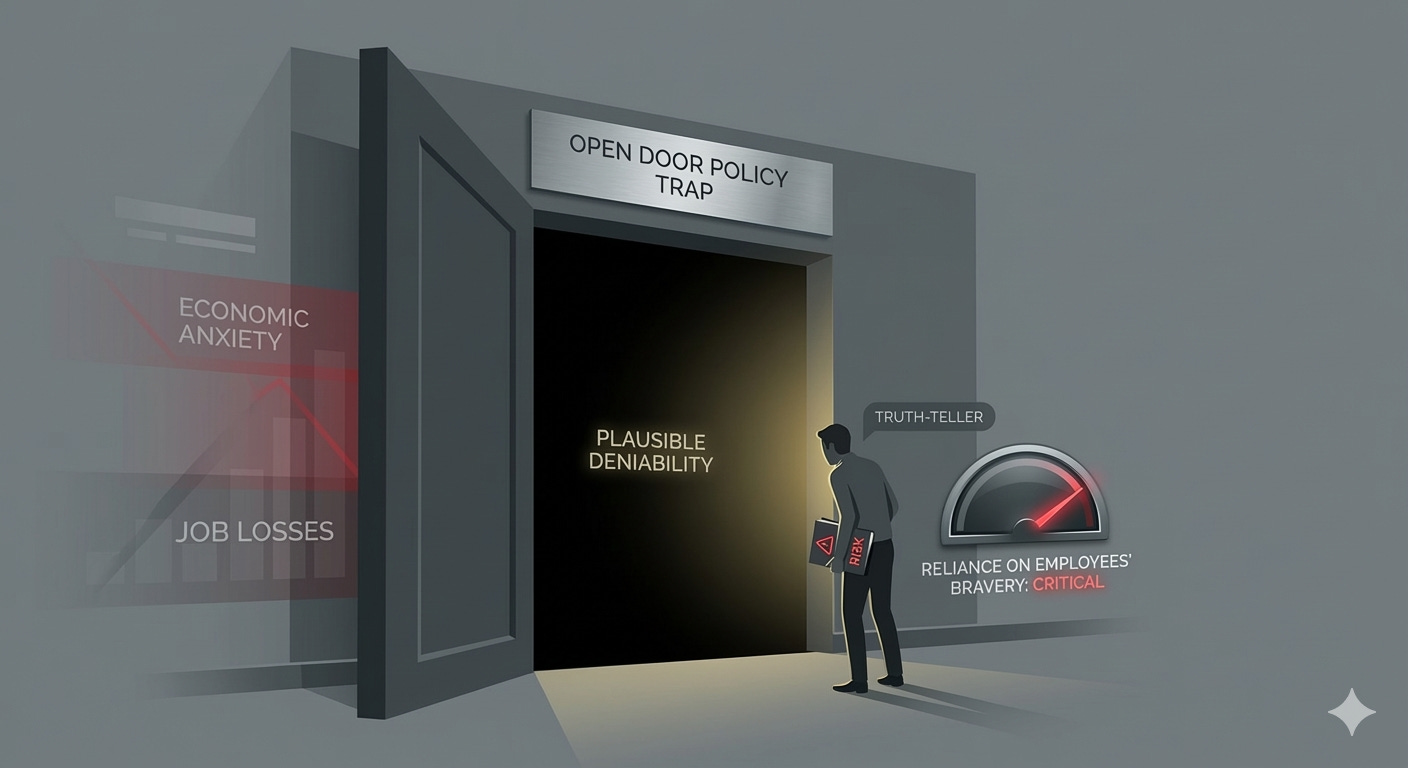
If the “Family” culture is the engine of intellectual dishonesty, the traditional “Open Door Policy” is its perfect trap door.
For decades, HR has championed the Open Door Policy as the ultimate symbol of corporate transparency. But in a dysfunctional “Family” environment (especially when employees are terrified of layoffs) it is a dangerous illusion.
The Burden of Bravery
The fundamental flaw of the Open Door Policy is that it places the entire burden of risk on the employee. It requires the least powerful person in the room to summon the courage to walk into the most powerful person’s office and deliver bad news.
It gives leadership ultimate plausible deniability. When a crisis erupts, the executive can say, “My door was always open, and nobody came to me!” They blame the staff for not speaking up, conveniently ignoring that the culture they built made speaking up equivalent to professional suicide.
