


I spent a good portion of last week fighting off a nasty winter bug. As I was staring at the ceiling, waiting for the antibiotics to kick in, I realized something important: The only reason my business didn’t implode while I was offline is because of a principle I strongly suggest my consulting clients & friends adopt.
I call it the 80% Capacity Rule.
In modern corporate culture, we treat “100% utilization” as the holy grail. We build operational plans that require every single employee to fire on all cylinders, 40+ hours a week, 52 weeks a year, just to hit baseline targets.
Here is the Strategic Realism: If your business model requires 100% human capacity to function, you don’t have a plan. You have a wish. You have thoughts & prayers.
You are exactly one flat tire, one sick kid, or one sinus infection away from operational collapse.
The Math Behind the Madness: Queueing Theory
This isn’t just an HR philosophy; it is a mathematical certainty.
If you look at Queueing Theory (the mathematical study of waiting lines and system flows), you’ll find a fascinating truth about highways. A highway operates beautifully at 80% or 85% capacity. Cars move swiftly, and people get where they need to go. But the moment that highway hits 100% capacity? It doesn’t just slow down a little bit. It turns into Los Angeles: complete gridlock. At 100% capacity, forward motion stops entirely.

Human beings work the exact same way.
In his brilliant book Slack: Getting Past Burnout, Busywork, and the Myth of Total Efficiency, organizational thought leader Tom DeMarco argues that obsession with 100% efficiency is actually destroying companies. When an organization is running with zero “slack” (no unallocated time), it loses its ability to adapt to change.

When 100% is your baseline expectation, 99% becomes a failure. The moment friction is introduced, the work doesn’t just get delayed; it backs up and crashes the whole system.
How to Build the 80% Rule into Your Operations
You cannot engineer the humanity out of your workforce, but you can engineer your operations to accommodate it. Here are three actionable ways to build strategic slack into your business:
1. Schedule for 32 Hours, Not 40 (Yes, Even for Exempt Employees)
When doing capacity planning, assume your team only has 32 hours of highly effective, heads-down working time a week. The other 8 hours belong to friction: context switching, human interactions, minor tech glitches, and simply letting the brain reboot.
A Friendly Compliance Reality Check (Especially for California Employers):
Do not fall into the trap of thinking capacity limits only apply to your hourly, non-exempt team. If you are treating your salaried, exempt employees like non-exempt workers by mandating they grind out 45 to 50 hours a week to hit an arbitrary 2,080+ annual hour quota, you are playing with fire.
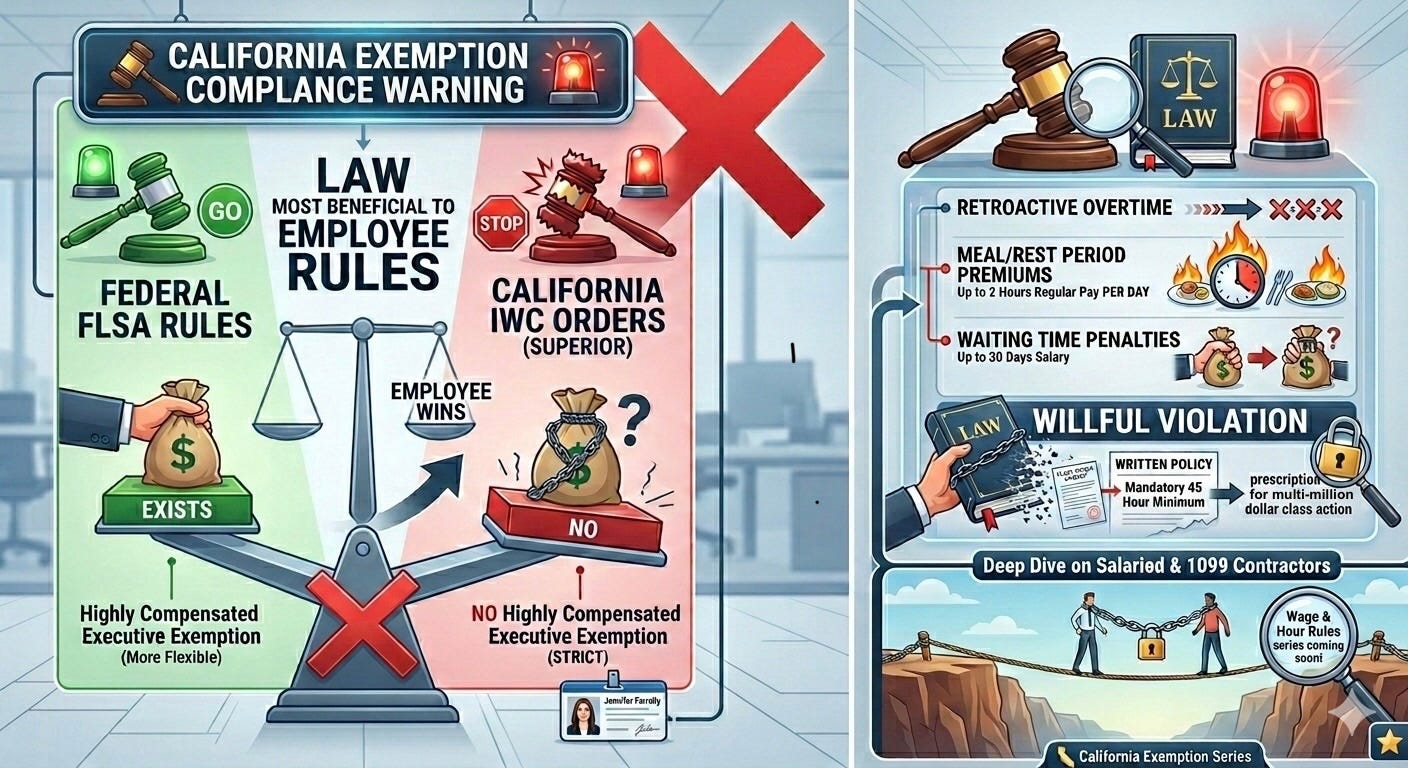
California has the strictest exemption tests in the country. (Rule of thumb: when state and federal labor laws conflict, the law most beneficial to the employee always wins. That means CA state law almost always trumps the federal FLSA. For example, that handy federal “Highly Compensated Executive” exemption? It does not exist in California.)
In California, exempt employees are paid for their independent judgment and discretion, and they must spend more than 50% of their time actually performing that elevated work. If you mandate exhausting 45- or 50-hour weeks, your exempt leaders inevitably end up doing routine, non-exempt busywork just to keep their heads above water. Suddenly, their actual daily duties drop below that 51% threshold, and you have a misclassification lawsuit on your hands.
The math gets ugly fast:
You owe them retroactive overtime.
Because you assumed they were exempt, you didn’t track their breaks. That’s up to two hours of premium pay per day for missed meal and rest periods.
Add in waiting time penalties of up to 30 days’ wages per employee.
Companies in California routinely face multi-million dollar class actions for this exact scenario. And if you wrote that mandatory “45-hour minimum” rule into your employee handbook? You just handed a plaintiff’s attorney written proof of a willful violation.
(Side note: The misclassification trap — both for salaried employees and 1099 contractors — is a massive, expensive risk right now. We are going to dive deep into a dedicated Wage & Hour series very soon. Stay tuned!)
2. Cross-Train the Glass Balls
Identify your single points of failure. If you only have one person who knows how to run Friday’s payroll, or only one account manager who understands your biggest client’s eccentricities, you are playing Russian Roulette with your company. You must have a “shadow” for every critical function.
3. Kill the “Zombie” Meetings
To give people 20% of their time back, you have to stop stealing it. Audit your calendar today. If a recurring meeting exists solely for status updates that could be read in a bulleted email, kill it. Give that hour back to your team so they have the slack they need to actually do the work.
The Realist Bottom Line
We have to stop praising organizations that run on fumes and adrenaline.
Building slack into your system isn’t lazy; it is the ultimate form of risk management. It means that when the inevitable storm hits — or when the Captain needs to take a sick day — the ship keeps sailing smoothly.
Is Your Team Running on Fumes?
If your operations snap the moment someone calls in sick, you have a structural vulnerability that is costing you money. Let’s look under the hood and build some resilience into your organization.
